

Image

SPIN
SPiN (Science & Philosophy in Namur) est un centre de recherche de l'Institut ESPHIN réunissant philosophes et scientifiques qui interrogent les sciences dans toute leur diversité, en croisant les approches épistémologiques, métaphysiques, politiques et éthiques.
Pluridisciplinaire et ouvert aux grands enjeux contemporains, SPiN explore les enjeux philosophiques des diverses disciplines des sciences naturelles, sociales, humaines et formelles.
Ses travaux, à la fois académiques et engagés, visent à mieux comprendre ce que sont les sciences, comment elles fonctionnent, comment les distinguer de ce qu’elles ne sont pas ou encore quels rôles elles jouent dans notre société.
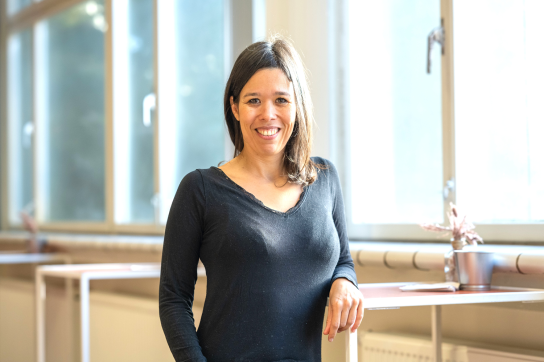
Are we prisoners of our genetic heritage? Can filiation be reduced to genes alone? Can we escape our destiny? Existential questions we all ask ourselves, and to which Gaëlle Pontarotti, lecturer and researcher in the Department of Sciences, Philosophies and Societies at UNamur, sheds new light in her book Par-delà les gènes. Une autre histoire de l'hérédité, published last October by Gallimard.
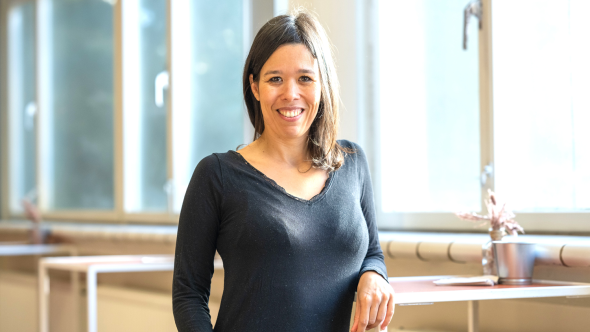
Until the end of the 20th century, heredity was seen by scientists as a matter of genes and DNA transmission. But in recent decades, research has revealed non-genetic transmissions, helping to explain why children on average resemble their parents more than other individuals in a population. These include epigenetic (changes in gene activity without changing the DNA sequence), microbial, hormonal and behavioral transmissions. Some biologists and philosophers now speak of "extended heredity".
"The challenge is to redraw the concept of heredity, going beyond the strictly genetic vision that has prevailed until now", explains Gaëlle Pontarotti. "The aim of my book and my research is to articulate different forms of transmission and to rethink the compatibility between heredity and transgenerational freedom."
For since Greek antiquity, everything suggests that we are locked into a family destiny. But if heredity goes beyond genes, what room for manoeuvre do we have? "The challenge is to find a happy medium between hereditary fatalism and the illusion of omnipotence in the face of our heritage", sums up the researcher.
This new concept overturns our vision of filiation and the status of the individual. We are no longer simply objects determined by causes beyond our control: we are once again actors in what we receive and transmit. It also invites us to reconsider the place of genes in filiation: is the parent fundamentally the one who transmits his or her genetic heritage?
And what if, ultimately, our heritage was also what we chose to make of it?
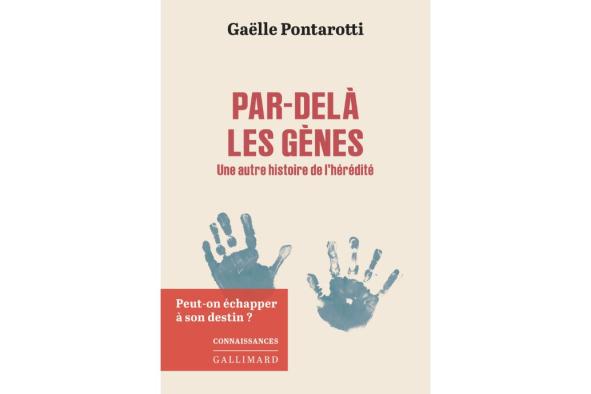
Cover credit: Éditions Gallimard, book visual Par-delà les gènes.
Par-delà les gènes. Une autre histoire de l'hérédité, by Gaëlle Pontarotti - Gallimard (collection Connaissances)
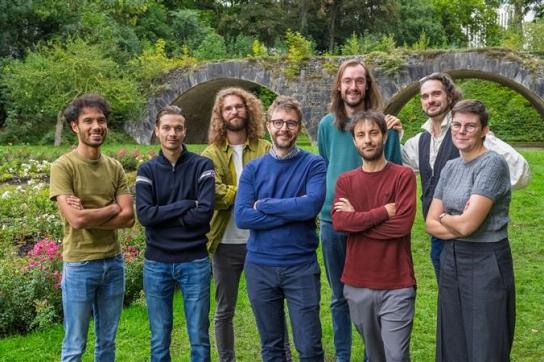
At a time when misinformation, post-truths and conspiracies are undermining confidence in science, UNamur welcomes SPiN (Science & Philosophy in Namur), a new interdisciplinary research center that questions the place of science in society. Founded last September by Olivier Sartenaer, Professor of Philosophy of Science at UNamur, SPiN brings together philosophers and scientists around a common vision: to develop a critical and accessible reflection on science in all its diversity.
.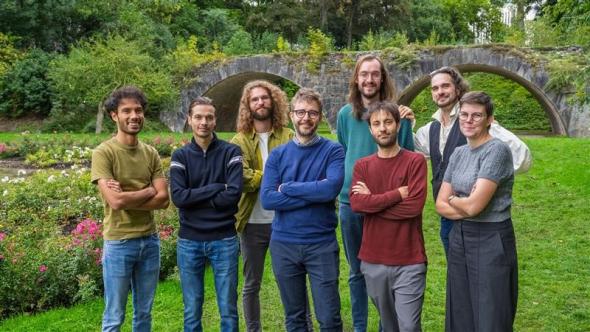
Olivier Sartenaer's team: Doan Vu Duc, Maxime Hilbert, Charly Mobers, Olivier Sartenaer, Louis Halflants, Andrea Roselli, Gauvain Leconte-Chevillard, Eve-Aline Dubois.
While UNamur is distinguished by the presence of a Philosophy of Science department within its Faculty of Science, until now there has been no research center specifically dedicated to the epistemological, ethical, political and metaphysical challenges of science. SPiN fills this gap.

"Several contingent factors enabled the creation of SPiN: the absence of a research structure specifically dedicated to these themes and the almost simultaneous arrival of four young philosophers of science. It's a bit like an alignment of the planets", explains Olivier Sartenaer.
At his side are Juliette Ferry-Danini (Faculty of Computer Science), Thibaut De Meyer (Faculty of Philosophy and Letters) and Gaëlle Pontarotti (Faculty of Science), who form the core of SPiN.
SPiN is part of a research dynamic committed to the heart of contemporary debates.

There is a real need for citizens to be enlightened on these issues. It was important for us that a research structure reflect this growing societal demand and host research on these themes.
SPiN researchers explore a wide range of themes, against a backdrop of questioning our relationship to scientific knowledge. These include:
This research is carried out by an interdisciplinary team of teacher-researchers, doctoral students and post-docs from the various faculties of UNamur.
SPiN organizes weekly seminars devoted to current research in philosophy of science, as well as seminars linked to more specific themes: health, life sciences, cosmology and theories of emergence and reductionism in the natural sciences.
But SPiN is not limited to the academic sphere: the center intends to take these issues outside the university walls, through events and activities accessible to all. An inaugural event is already planned for next spring on a topical theme: mistrust in science. More info to come!
The SPiN research center invites you to its inaugural event.
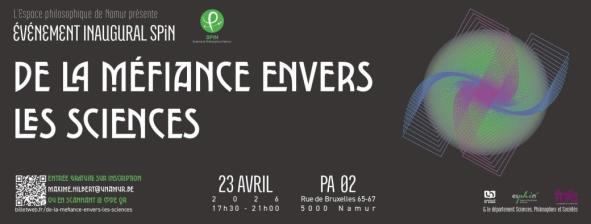
For its inaugural conference, the SPiN (Science & Philosophy in Namur) center will be joined by Claire Rommelaere, a lawyer and researcher at the Center for Bioethics at the University of Namur, and Aude Bandini, a philosopher of science at the University of Montreal, to take a critical look at the theme of "distrust of science." The urgency of addressing this issue is clear in our era, where, despite an overall stable level of trust in science, the parameters of public debate are frequently blurred by misinformation.
Having had the opportunity to observe philosophers of science in their natural habitat for nearly fifteen years, Claire Rommelaere will share her thoughts on whether or not we should trust those who think about science.
For her part, Aude Bandini will address a major problem that we all face at a time when the mass of available knowledge is such that it is impossible to acquire it on our own. Indeed, the socially distributed nature of knowledge generally leaves us no choice but to rely on the authority of experts, even on very important issues (such as health). However, when we rely on others in this way and follow recommendations that, due to our ignorance, we have no means of evaluating, we place ourselves in a relationship of "epistemic dependence" that conflicts with our aspirations for intellectual autonomy and forces us to ask ourselves a question whose answer may prove unbearable: is intellectual autonomy nothing more than a myth?
Conference hosted by journalist Maïté Warland.
Program:
Registration deadline: April 16.
Free of charge.
Conference organized by the SPiN Research Center at the ESPHIN Institute.
A plant does not seem to have much in common with animals. Yet naturalists of the eighteenth and nineteenth centuries attempted to study plants as if they were animals: they set out, for example, to find an equivalent to the circulatory or respiratory systems. Why did they feel the need to resort to analogical reasoning? What results did they obtain? And more generally, what is the value of this type of reasoning?
12:15 PM – Welcome and light lunch
1:30 PM – Introductory remarks
Thibault De Meyer (University of Namur): Why Analogy?
2:15 PM – Session 1: Theory and Practice - Cristiana Oghina-Pavie (University of Angers): The analogy of pragmatic knowledge: actions and transactions in 19th-century horticulture and Quentin Hiernaux (FNRS / Free University of Brussels): The plant-animal analogy employed by A.-P. de Candolle’s physiology in addressing the issue of the sensitivity of living beings
3:45 PM – Coffee break
4:15 PM – Plenary Session 1 - Thierry Hoquet (University of Paris Nanterre): Is the plant/animal analogy valid?
5:45 PM – End of the first day
7:00 PM – Conference dinner
9:00 AM – Welcome
9:15 AM – Session 2: Relationships and Boundaries of the Living - Dario Galvão (University of Namur): Analogy and the Faculties of the Living: Animal Reason and Plant Sensibility in the Enlightenment and Ugo Batini (University of Poitiers): Understanding Humanity Through Plants: Analogy and the Metaphysics of the Living in Schopenhauer
10:45 AM – Coffee break
11:15 AM – Plenary Lecture 2 – Pascal Duris (University of Bordeaux): Plants as Humans. Analogy in Linnaeus and the Linneans
12:45 PM – Lunch break
2:00 PM – Toward New Disciplines - Vera Staetmanns (Ruhr University Bochum): Do Plants Think? Analogy in the Plant Psychology of Raoul Heinrich Francé (1874–1943) and Matthieu Amat (University of Rouen Normandy): Analogy and Homology: Transfers from the Life Sciences to the Cultural Sciences in the 19th Century
3:30 PM – Coffee break
4:00 PM – Plenary Session 3 - Aliènor Bertrand (CNRS / ENS de Lyon): “Les œufs du vent” and Their Descendants
5:30 PM – Closing of the conference
5:45 PM – End of the day
Contact: Dario Galvao - dario.galvao@unamur.be
