The Department is interested in past and present societies through the study of material traces and productions, whether archaeological or architectural remains, objects or artistic works. Openness and diversity are the guiding principles of the Department of Archaeology and Art Sciences.
The aim of Archaeology and Art Sciences studies is to train future heritage professionals in research methods and knowledge specific to these disciplines. Field practice in direct contact with sites, objects and works is at the heart of our teaching methods. Based on the observation and characterization of traces of occupation or materials fashioned by man, students are led to interpret them from the angle of their contexts of production and use, questioning their meaning.
Research in the department covers a wide range of artistic and technical fields, from prehistory to the present day.
Find out more about the Department of Archaeology and Art Sciences
Spotlight
News
When photography explores the (geo)political, economic, and environmental issues surrounding nuclear power
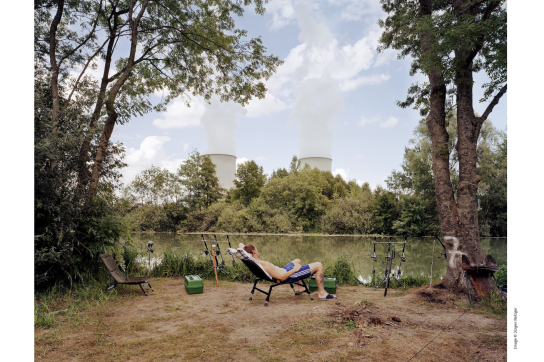
Between the risks of “globocide” and the long-term management of nuclear waste, nuclear power embodies the anxieties of our time while remaining largely invisible in public discourse. Based on FNRS research led by Danielle Leenaerts, a lecturer in the Department of Archaeology and Art Sciences, a three-part project comprising an exhibition, a book, and an interdisciplinary study day offers a unique insight into how Belgian and international artists depict nuclear power.
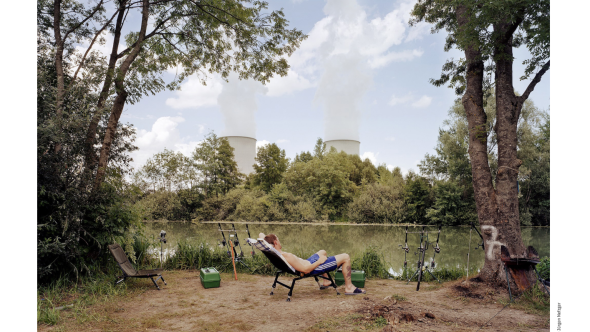
While the extension of the Tihange and Doel power plants has drawn little reaction, Danielle Leenaerts’ research project uses art to reignite the discussion in a novel way. This project is unique in that it explores representations of civil and military nuclear energy across various media that engage in dialogue with one another, namely: a photo exhibition at the Delta, a book, and a study day. Her work brings together the perspectives of artists with diverse viewpoints and rejects the polarization of the debate. The goal is rather to encourage society to face a reality it strives to conceal. This approach demonstrates that culture and research are essential tools for addressing today’s geopolitical and environmental challenges. Interview.
How did this research project on how photographers depict nuclear power come about?
This project runs parallel to my teaching of contemporary art history. As part of this, I received an FNRS–PDR research grant, which provided a broader foundation for the project. This allowed me to structure it in three parts: an exhibition, a book, and a study day.
I am interested in nuclear energy because this theme encapsulates the core political, geopolitical, and human issues of the past 75 years. On the one hand, with the invention of the atomic bomb, regarding military nuclear power, and on the other hand, with the exponential growth in the use of civil nuclear power for energy production. According to the philosopher Günther Anders, we have in fact entered the “atomic age” with the constant risk of “globocide”—that is, the possibility of destroying all life on the Earth’s surface. And we are fully aware of this reality when it comes to military nuclear power. But humans are also in denial about the risks inherent in the use of civil nuclear power, as the Fukushima disaster recently demonstrated. This is a true cognitive dissonance because we know the risks and the duration of the potential fallout, yet we do not react. Worse still, our energy consumption is skyrocketing, as civil nuclear power is presented as the primary solution to decarbonization. A solution that sidesteps the issues of risk and the management of nuclear waste, whose half-life spans several centuries or tens of millennia. These absolutely essential questions must be discussed by civil society but are not. This is also what I aim to achieve with this research project: to enable a public debate on the issue of nuclear power, because it concerns us all and will have an impact on our future.
Why did you choose photography? In your opinion, what does it offer that other mediums don’t?
Photography was already the subject of my dissertation, so this issue has been on my mind for a long time. It is my primary area of focus in both teaching and research. Indeed, photography has long been conspicuously absent from art history research, which has traditionally focused primarily on the fine arts in the broadest sense. For me, it was also important to introduce this type of representation into the academic field, particularly in the history of contemporary art. Along the way, I became aware of a whole series of works dealing with nuclear energy, and I saw them as an attempt to bring these issues to light. These artists’ works allow us to engage with questions that are not addressed in the media or are addressed in a simplified, even polarizing manner.
I also wanted to avoid anything fictional regarding the nuclear issue. Photography serves as documentary evidence, yet at the same time, it offers a representation that speaks to the world through an aesthetic medium that invites us to pause and reflect. Photography is an art form that allows us to associate images with concepts and to humanize the nuclear issue.
Nuclear energy is at the center of current events, amid climate concerns, aging infrastructure, and geopolitical tensions. How does this news shape the reception of these works?
Currently, the government has decided not to phase out nuclear power and has extended the operating life of the Tihange and Doel plants. I am very surprised by the lack of reaction from civil society on this issue. Decarbonization is, of course, necessary, but nuclear power is not the only solution. Moreover, it is a solution that poses numerous risks and is highly polluting. We’re talking about radioactive waste that will remain radioactive for thousands of years. This projects us into time frames that are unimaginable. It is one of the major challenges in how the public will receive the exhibition. I hope this exhibition will help identify the issues and risks while there is still time to change things. I am therefore very curious to see how the public will react and am very grateful to the Delta for hosting the exhibition project. The Delta and Confluent des Savoirs have also worked to make the information accessible to the general public in order to communicate our knowledge about nuclear power more effectively. This information provides a framework for the exhibition, but the interpretation of the works remains entirely up to the public. Everyone is free to interpret them as they wish. In any case, I hope this exhibition will prompt the public to ask questions and spark a debate.
How did you select the ten Belgian and international artists on whom your work is based?
Starting with the Belgian context and an artist, Cécile Massart, who for 30 years has dedicated herself to the issue of civil nuclear power and waste management—and more specifically to raising awareness of storage sites. Cécile Massart has created markers for underground storage sites. Her pioneering work raised my awareness of nuclear issues. I also came across the work of a young photographer who focused on Tihange for his graduation project. A Belgian focus therefore made sense. Then, my interest in nuclear accidents led me to other photographers, such as Anaïs Tondeur. Finally, I became interested in military nuclear power, and other photographers came to the forefront. Ultimately, the ten selected photographers offer a diverse representation of the nuclear chain (waste, material processing, decommissioning, activist occupation, etc.) and both civilian and military issues.
The photo exhibition isn’t the only medium you’re using to present your research. You’re also publishing a book, titled after the exhibition, and organizing a study day. How does the book complement or extend the exhibition experience?
The book, *(Faire) face au nucléaire*, which will be released in late March, and the exhibition are two separate mediums. The book is not a catalog of the exhibition. It features most of the artists but not necessarily the works on display. The book allows for a deeper analysis and contextualizes the understanding of nuclear power in relation to the artworks. It also explores the aesthetics of the works in greater depth. The data presented in the book is also more detailed and precise than that featured in the exhibition. The book outlines the results of in-depth research. But I want to clarify that the book’s focus is art history, not physics. It does, however, help readers grasp the general context, key elements, and major issues surrounding nuclear energy.
The book also helps readers understand the artists’ positions on the nuclear issue. Some are anti-nuclear, while others take a more nuanced stance. The book thus presents a full spectrum of viewpoints on the issue. I hope it will also foster public debate and move beyond the polarized “for” or “against” positions on nuclear power. The book aims to reintroduce factual information into the debate, rather than opinions, and to refocus attention on the question of life. It seeks to offer knowledge and nuance.
After two years of research, what is your current perspective on how art can contribute to our understanding of nuclear energy?
I am more convinced than ever that this is a healthy space for expression. These works give concrete form to the abstract. Photography is a powerful artistic medium that has fostered an interest in these issues. Art allows for an unprecedented space of freedom. But the scope of artistic expression still needs to be defended. My research is also significant from this perspective. It shows that artistic expression is possible even when culture faces budget cuts.
Does this research pave the way for new projects?
I’m not sure yet. Bringing this project to fruition was a major challenge. I’ll continue to support the project and share it through other formats and channels (lectures, videos, etc.) to keep it alive. In the near future, I hope to continue exploring contemporary art in French-speaking Belgium and to keep engaging with social issues.
“Facing Nuclear Power: The Exhibition”
March 28–August 2, 2026
Admission: €10 > €5
The exhibition is open from 11 a.m. to 6 p.m. Tuesday through Friday and from 10 a.m. to 6 p.m. on Saturdays and Sundays.
For all ages
Related events:
- May 28 at 7 p.m.: Screening of “R.A.S. Rien à signaler,” a documentary by Alain De Halleux
- Special offers for groups: discover the various options that allow you to explore this exhibition in depth: guided tour, creative workshop tour, philosophy workshop tour, and activities as part of “Printemps des sciences.”
“Facing Nuclear Power: The Book”
Coming out in late March
La Lettre Volée Publishing
€25
Special Feature: “Confronting Nuclear Power: The Study Day”
Friday, March 27, from 9:30 a.m. to 5:30 p.m.
At the B&LC (5 Rue Godefroid, Namur)
The morning will be devoted to nuclear power as viewed through the lens of the natural sciences and the humanities. The afternoon will feature presentations by artists.
“Facing Nuclear Power: The Book”
Coming out in late March
La Lettre Volée Publishing
€25
Special Feature: “Confronting Nuclear Power: The Study Day”
Friday, March 27, from 9:30 a.m. to 5:30 p.m.
At the B&LC (5 Rue Godefroid, Namur)
The morning will be devoted to nuclear power as viewed through the lens of the natural sciences and the humanities. The afternoon will feature presentations by artists.
The Department of Physics welcomes a delegation from CERN
In May 2025, the Department of Physics welcomed two special visitors: Serge Mathot and François Briard from Namur, both alumni of UNamur and members of CERN. Several activities were on the program, ranging from a visit to the particle accelerator, to science popularization and thematic seminars, particularly in heritage sciences. The aim? To identify areas or activities in which UNamur and CERN could strengthen their collaboration.
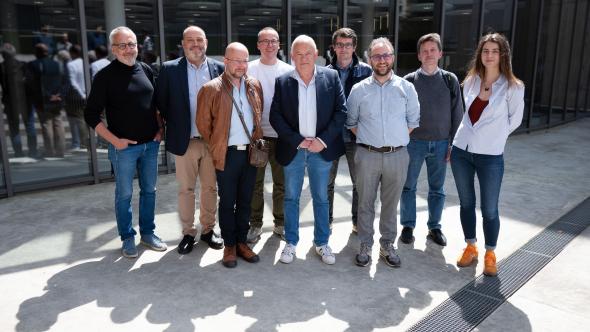
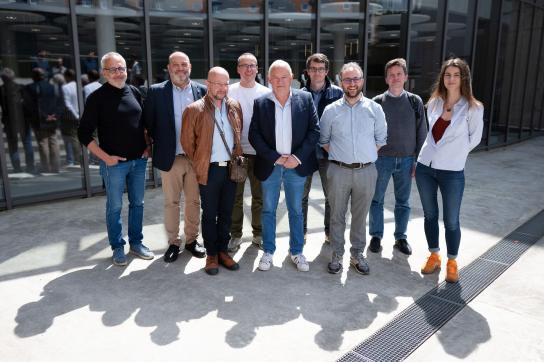
In the picture, from left to right: (top) Pierre Louette, Director of the Physics Department; François Briard, Head of the Science Portal Group (CERN); Julien Colaux, IBA specialist, physics researcher; Boris Hespeels, biology researcher; Alexandre Mayer, physics researcher; Anne-Catherine Heuskin, physics and biophysics researcher. (bottom) André Füzfa, astrophysicist and mathematics researcher; Serge Mathot, Applied Physicist (CERN) and Michaël Lobet, physics researcher.
The love affair between CERN and UNamur goes back a long way. CERN's accelerator complex and experimental program are very different and much larger than those of UNamur's Physics Department, but the fields in which the two institutions work have much in common.
In addition, both guests have a personal history with UNamur. The Physics Department was pleased to welcome Serge Mathot, Referent Applied Physicist (CERN) and alumni of the UNamur Physics Department (1992), as well as François Briard, Group Leader Science Portal (CERN), and alumni of the UNamur Faculty of Computer Science (1994).
The activities began with a meeting between the guests, Rector Annick Castiaux, Vice-Rector for Research Carine Michiels, Physics Department Director Pierre Louette and several other members of the Physics and Biology Department. After a general presentation of the University, the participants pointed out the missions shared by both institutions: research and the transfer of technology and knowledge, service to society, scientific popularization and education and training.
.
Focus on meetings
Physics lunch - CERN presentation
The physics lunch is the monthly meeting between students and members of the physics department and a professional, alumni or not, coming to explain his or her background and what he or she does on a daily basis as a physicist.
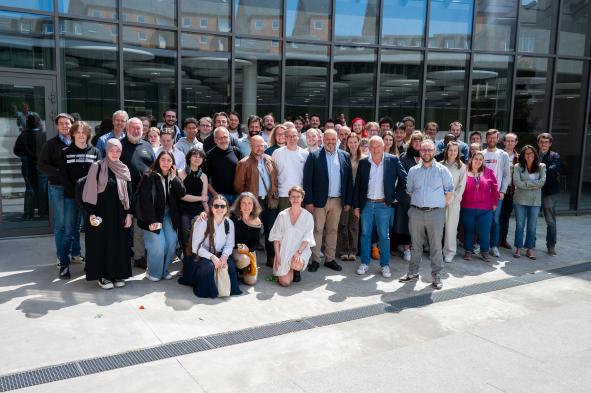
During this meeting, attended by around 80 people, François Briard and Serge Mathot presented CERN, the world's largest laboratory for particle physics. CERN's mission is to understand the most elementary particles and the laws of our universe.
At the end of the seminar, the students came away with stars in their eyes. Indeed, opportunities for internships or even first jobs at CERN are possible for physicists but also in many other fields.
Your physics training at UNamur is your best ticket to a job at CERN. It's more than just a degree in particle physics!
Some internship programs at CERN are particularly well suited to the needs of young Belgian students.
The vast majority of physicists working with CERN (over 13,000) are in fact sent to CERN for varying periods of time by their employing national research institutes. CERN offers an exceptional opportunity to develop international experience under excellent conditions, in an environment that is unique in the world! What an inspiration for our young students!
Visit of the ALTAÏS and SIAM facilities
Capable of generating ion beams consisting of any stable element with energies of up to 16 Mega electron-Volt (MeV), the ALTAÏS particle accelerator is used in various fields of fundamental and applied research, notably through industrial partnerships. CERN's largest current linear accelerator can produce particle beams of up to 160 MeV.
Meeting with members of the ARC PHOENIX project, complemented by a heritage science seminar given by Serge Mathot.
The projet d'Action Recherche Concertée (ARC) PHOENIX aims to renew our understanding of medieval parchments and ancient coins. Artificial intelligence will be exploited to analyze the data generated by material characterization.
This joint study between the Department of Physics and the Namur Institute of Structured Matter (NISM) and the Department of History and the Institut Patrimoines, Transmissions, Héritages (PaTHs) will address questions relating to the production chain and use of these objects and materials in past societies.
At the same time, Serge Mathot presented a seminar in heritage science attended by some 50 people. In particular, he presented his research and the brand-new ELISA accelerator: a miniaturized gas pedal capable of delivering a 2 MeV proton beam used to perform real measurements at the Science Portal.
Meeting on science popularization
Having the opportunity to exchange views with François Briard, Group Leader of the CERN Science Portal is a rare opportunity. Comparing outreach activities has opened up new avenues, discovering and sharing approaches, assessing what works and what doesn't, depending on the target audience. A highly satisfying enrichment for the members present from Confluent des Savoirs (CDS), the University of Namur's research outreach and dissemination service.
The CERN Science Portal is a place where you can explore CERN and science through authentic and innovative experiences: immersive multimedia exhibitions, hands-on lab workshops, science shows, events combining science and culture, prototyping workshops on the theme of innovation, tours of CERN sites, all accompanied by CERN staff.
BD Physix - Energy
Teachers André Füzfa and Michaël Lobet were able to present the comic strip project created with author Jean-Marc Dubois.
The theme? Energy!
What could be more natural than to talk about it with François Briard, chief popularizer at CERN, who is interested in this popularization project in a medium accessible to people aged 7 to 77!
Meeting on the theme of biophysics
Professor Anne-Catherine Heuskin and Dr. Boris Hespeels are currently working on the BEBLOB project, a Belspo project with ESA support, as part of the UNIVERSEH (European Space University for Earth and Humanity) alliance. They are particularly interested in its astonishing ability to withstand high doses of radiation.
Anne-Catherine Heuskin also works in radiobiology. Particles are used to irradiate cancerous cells in order to destroy their genetic material and prevent them from proliferating: this is the basis of radiotherapy and proton therapy.
Meeting with FaSEF regarding teacher training opportunities.
The meeting confirmed the willingness of FaSEF and UNamur to get involved in coordinating the Belgian National Teacher Programme in French-speaking Belgium, which CERN intends to relaunch in 2026. Consideration was also given to other avenues for teacher training, such as CERN's forthcoming involvement in the "Salle des Pros", the training venue for the various players involved in teacher training at UNamur.
.A visit to TRAKK
The TRAKK is Namur's creative hub supported by 3 complementary partners in the field: BEP, KIKK, and UNamur. In addition to the venue, François Briard was able to visit the ProtoLab , which bridges the gap between ideas and industry by being a decentralized research and development hub accessible to SMEs and project leaders by offering advanced support in prototyping products or services.
Guests at CERN
François Briard - CERN Science Portal Group Leader, UNamur alumni 1994
Specialities:
- Information systems, administrative applications and databases (Oracle)
- Communications for the general public
- Visitor reception logistics
- Event organization for up to 80,000 participants.
Graduating in law and information technology management (DGTIC) in 1994 after his bachelor's and master's degrees in computer science in 1993, François Briard works at CERN, the European Organization for Nuclear Research in Geneva, the world's largest particle physics laboratory.
During his school career, which was 100% at UNamur, he was vice-president of the Régionale namuroise and student delegate during his years as a candidate in economic and social sciences, computer science option.
Thanks to the multidisciplinary training provided at UNamur, he was able to seize several opportunities to redirect his career at CERN, where he was an information systems engineer from 1994 and then, from 2014, redirected his career until he became Group Leader of the Science Portal, which is CERN's general public communications center.
Serge Mathot - Referent Applied Physicist at CERN, UNamur alumni 1992
His specialties
- Ion Beam Analysis (IBA)
- Metallurgy, vacuum brazing
- Radio-Frequency Quadrupole (RFQ) linacs, ion sources
Serge Mathot obtained his doctorate in applied sciences from UNamur in 1992, following his bachelor's degree in physical sciences in 1985.
He then carried out a post-doctorate at the Joint Research Center (EU science hub) in Geel, which aims to bring together multidisciplinary skills to develop new measurement methods and tools such as reference materials.
He perfected his expertise in physical metallurgy before joining CERN in 1995 as a Referent Applied Physicist. He has worked on numerous research projects (CLOUD, MACHINA, ELISA...) and developed numerous parts for the manufacture of CERN's gas pedals.
It's a great pleasure to meet him.CERN
CERN, the European Organization for Nuclear Research, is one of the world's largest and most prestigious scientific laboratories. Its vocation is fundamental physics, the discovery of the constituents and laws of the Universe. It uses highly complex scientific instruments to probe the ultimate constituents of matter: the fundamental particles. By studying what happens when these particles collide, physicists understand the laws of Nature.
The instruments used at CERN are particle gas pedals and detectors. Gas pedals carry beams of particles at high energies to collide with other beams or fixed targets. Detectors observe and record the results of these collisions.
Founded in 1954, CERN is located on either side of the French-Swiss border, near Geneva. It was one of the first organizations on a European scale and today has 25 member states, including Belgium.
Physics programs at UNamur
From the infinitely small to the infinitely large, from elementary particles to galaxies, are you thirsty to understand the whys and wherefores of the natural phenomena you observe? Physics answers all your questions.
Pedagogy in the field - Archaeological field schools
As part of their training in archaeology, students at the University of Namur experience a unique immersion in their future profession thanks to workcamps. This program, developed by the Department of Archaeology and Art Sciences, closely combines field experience and academic learning.
This article is taken from the "Tomorrow learn" column in the December 2024 issue of Omalius magazine.
This initiative is spearheaded by Fanny Martin, lecturer in national archaeology at UNamur. "Leaving archaeology studies without having experienced the discipline doesn't make much sense. When I arrived, the University of Namur didn't yet have any field schools. It seemed essential to me to offer a project for students, because field archaeology is a discipline in its own right," she explains. Julian Richard, professor of Greek and Roman archaeology and head of the department, adds: "At UNamur, our trump card is to take students out into the field as much as possible. Right from the bachelor's level, they are brought into contact with the object, observing it, manipulating it, understanding it. This is a pedagogy we're keen on, and setting up work-schools is part of it."
During these work-schools, students, confronted with the realities of the field, have to apply their theoretical knowledge to concrete situations, developing not only their technical skills, but also analytical and problem-solving abilities. "In the first and second years, students receive a methodological background on excavation. And then, between their second and third years, they go out on the training site for two weeks and put these principles into practice," adds Fanny Martin.
These internships offer an immersive experience. Bérénice Didier, an art history and archaeology student, worked on the site of Tintigny, an Iron Age tomb necropolis in the Gaume region, while others went to the Feudal castle of Moha, in the Province of Liège.
I got a lot out of this internship. The team on site was lovely. We first learned the basics of excavation, then, little by little, explored all the stages of the discipline, which was exciting", she recounts. Marion Drabbé, a third-year bachelor's student in archaeology, backs up Bérénice's words, adding, "I was a little apprehensive, as the workcamps are like a little exam in our curriculum. But in the end, it was a great experience. We were surrounded by lovely professionals, and I was supervised by Fanny Thirion, archaeologist at the Musée des Celtes. It was great! These workcamps let you see what you're studying, and you realize just how precise and meticulous archaeology is. There's also the satisfaction of discovering previously unseen objects: we found an urn with bone residues and a fibula pin, which is quite rare in excavations. We were delighted!".
The experience of workcamps is not just professional. For Bérénice Didier, it was also a time for sharing and cohesion: "It felt a bit like summer camp. It was really great and I had the opportunity to forge a lot of bonds." Outside digging hours, the students share their daily lives, which fosters strong bonds and develops their ability to work as a team.
These workcamps, which constitute research projects in their own right, require significant organization and varied support. "We chose to work in the Tintigny region, in Gaume. The site is in conservation danger, and we benefit from funding from the Agence wallonne du Patrimoine as well as a partnership with the Musée des Celtes de Libramont and the Commune de Tintigny to carry out the operations. This type of project requires a lot of collaboration to manage the logistics and the study," explains Fanny Martin. What's more, support from partners and UNamur means that internships are free of charge, so that no student is deprived of this opportunity.
A dual mission and an opening onto the professional world
These projects fulfill a dual societal mission: to preserve and pass on heritage to society. With this in mind, students welcome visitors to the site to share their discoveries, enabling them to acquire cultural mediation skills. Bérénice testifies: "Giving guided tours really appealed to me, to the point of making me want to explore this field in the future". Marion adds: "The tours were really enriching. You realize that being able to express your budding knowledge in front of people who are interested in what you're telling them is also very glorifying". This dimension makes these internships much more than mere digs: they are also places of transmission where students value their work to society.
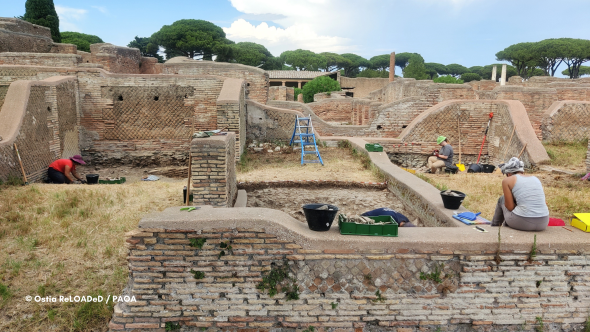
The work sites are also a first experience in the professional world. "They offer them a first baggage for the future", notes Julian Richard. Students can also take part in international missions, such as those organized by Julian Richard in Ostia, the ancient port of Rome, with UCLouvain. These excavations abroad bring a complementary perspective and enrich their training through the study of other contexts, particularly built, as well as other periods.
Thanks to this approach, UNamur archaeology students develop a deeper understanding of their field while building a useful professional network for the future. The workcamp-school becomes a landmark experience, preparing students both academically and personally for the rest of their career.
A new name for the department!
The department was recently renamed the Department of Archaeology and Art Sciences. According to Mathieu Piavaux, a professor at UNamur and former head of the department who contributed to the project, "this change had two objectives. Firstly, to highlight a very practical approach to archaeology, which is strongly emphasised in our teaching approach and in the scientific activity of the department. This is true not only of the courses devoted to archaeological methods and the technology of objects and architecture, but also of the practical work carried out by the students and the courses given in situ. Secondly, we have opted for a name of Germanic origin, “art sciences” (Kunstwissenschaft), which covers a much broader field than art history stricto sensu and is therefore better suited to the diversity of approaches in our disciplines, which include museology and heritage conservation, for example. The new name also reflects the versatility of the department, which is involved in specialised Masters courses in heritage management and conservation. Finally, putting “sciences” in the name is also a nod to the Faculty of Science, with which we regularly collaborate, given the interdisciplinary nature of our disciplines. It all adds up to a great team effort, a great collective dynamic that makes this kind of evolution possible. Redefining ourselves together and developing our identity is always exciting.
This article is taken from the "Tomorrow learn" section of Omalius magazine #35 (December 2024).
Participatory funding: Specularia, experimental archaeology project
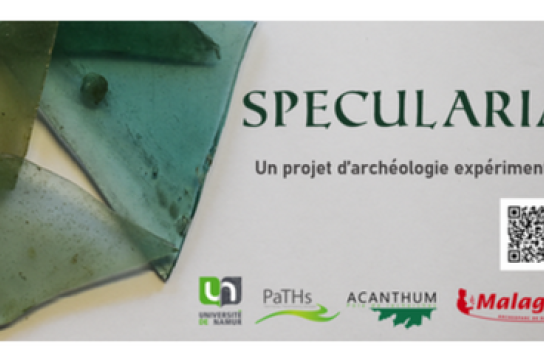
The Department of Art History and Archaeology of UNamur is participating for the first time in an experimental archaeology project, within the framework of a doctoral thesis on the production of glass in the Roman period. Conducted in partnership with Malagne, the Rochefort archaeopark, the Specularia project aims to gain a better understanding of the reality of the gestures and techniques of Gallo-Roman craftsmen and to scientifically validate hypotheses that are still debated today. To carry out this experiment, the Department of Art History and Archaeology is launching its first participatory funding.
Y avait-il déjà des vitres aux fenêtres au temps des Romains ? La réponse est oui ! Vertes, bleues, jaunes ou incolores, les vitres avaient des formes et des usages variés. La manière dont ce verre à vitre était produit à l'époque romaine continue cependant de faire débat entre les scientifiques. À l'UNamur, les archéologues tentent de percer les secrets de cette production, en partenariat avec des artisans verriers et Malagne, l’archéoparc de Rochefort. Cette expérience s'inscrit dans la thèse de doctorat menée à l’UNamur par Géraldine Frère, sous la direction du professeur Julian Richard.
Chercheuse doctorante, Géraldine Frère étudie depuis 2019 les productions et les usages du verre à vitre entre le 1er et le 5e siècle en Gaule Belgique et en Germanie inférieure, un vaste espace qui correspond à la Belgique actuelle, aux Pays-Bas, au Luxembourg et au nord de la France. Sa recherche est à l’origine du projet Specularia (de specularis, vitres ou fenêtres en latin).
Expérimenter un processus jamais tenté
Le projet entend décrypter les pratiques des artisans romains en recréant deux fours à verre « à l’antique » au sein de l’archéoparc. Le premier sera utilisé pour la fusion du matériau, l’autre pour sa recuisson, deux étapes indispensables de la production du verre. L’expérience sera menée par Géraldine Frère avec l'aide d’artisans verriers (Allain Guillot et "Les infondus") qui utiliseront des techniques et des outils "à la romaine", spécialement conçus sur base d’expérimentations antérieures et des traces retrouvées sur les fragments de vitres antiques. Le verre sera mis en forme suivant un processus inédit et différent de tout ce qui a été testé jusqu’ici : le verre en fusion sera cueilli dans le four, déposé sur une surface avec un cadre chauffée préalablement, puis étiré à l'aide d'outils jusqu'à obtention d'une forme rectangulaire.
Un objectif scientifique et pédagogique
Ce projet permettra aux étudiantes et aux étudiants du Département d’Histoire de l’Art et d’Archéologie de suivre un projet d’archéologie expérimentale en région namuroise. Le public pourra également voir la progression de l’expérience, de la construction des fours dans l’archéoparc au coulage des vitres, avec comme point d’orgue « le Rendez-vous gallo-romain » organisé les 15-16 juillet 2023. Les résultats des expériences seront valorisés scientifiquement dans le cadre du projet de recherche Specularia.
Un financement participatif
Pour mener cette expérience à bien, le Département d’archéologie est à la recherche de 10.000 euros. Cette somme sera intégralement utilisée pour acheter les matériaux permettant de construire les fours et couler le verre (bois, argile, sable, tuiles…) au sein de l'archéoparc et financer le travail des verriers durant la durée de l’expérience (mai-juillet 2023).
Si vous souhaitez faire progresser les connaissances en archéologie gallo-romaine, il vous est possible de rejoindre l’équipe du projet en participant à son financement. Chaque geste de soutien, petit ou grand, sera aussi un encouragement moral à poursuivre ces projets d’innovation en recherche et en enseignement dans le domaine de l’archéologie à l’UNamur !
Soutenez le projet et recevez une contrepartie offerte par Malagne, l’archéoparc de Rochefort
En fonction du montant de votre don, vous débloquerez l'une des contreparties offertes par l’archéoparc (entrées et visites guidées gratuites, participation au week-end gallo-romain…). Rendez-vous sur la page du projet !
Tous les dons à partir de 40 € adressés à l’UNamur, en ligne ou par virement, sont déductibles fiscalement et donnent droit à une réduction d’impôts de 45 %. Un don de 100 € vous coûtera en réalité 55 € après déduction fiscale.
Merci pour votre soutien !
When photography explores the (geo)political, economic, and environmental issues surrounding nuclear power
Between the risks of “globocide” and the long-term management of nuclear waste, nuclear power embodies the anxieties of our time while remaining largely invisible in public discourse. Based on FNRS research led by Danielle Leenaerts, a lecturer in the Department of Archaeology and Art Sciences, a three-part project comprising an exhibition, a book, and an interdisciplinary study day offers a unique insight into how Belgian and international artists depict nuclear power.
While the extension of the Tihange and Doel power plants has drawn little reaction, Danielle Leenaerts’ research project uses art to reignite the discussion in a novel way. This project is unique in that it explores representations of civil and military nuclear energy across various media that engage in dialogue with one another, namely: a photo exhibition at the Delta, a book, and a study day. Her work brings together the perspectives of artists with diverse viewpoints and rejects the polarization of the debate. The goal is rather to encourage society to face a reality it strives to conceal. This approach demonstrates that culture and research are essential tools for addressing today’s geopolitical and environmental challenges. Interview.
How did this research project on how photographers depict nuclear power come about?
This project runs parallel to my teaching of contemporary art history. As part of this, I received an FNRS–PDR research grant, which provided a broader foundation for the project. This allowed me to structure it in three parts: an exhibition, a book, and a study day.
I am interested in nuclear energy because this theme encapsulates the core political, geopolitical, and human issues of the past 75 years. On the one hand, with the invention of the atomic bomb, regarding military nuclear power, and on the other hand, with the exponential growth in the use of civil nuclear power for energy production. According to the philosopher Günther Anders, we have in fact entered the “atomic age” with the constant risk of “globocide”—that is, the possibility of destroying all life on the Earth’s surface. And we are fully aware of this reality when it comes to military nuclear power. But humans are also in denial about the risks inherent in the use of civil nuclear power, as the Fukushima disaster recently demonstrated. This is a true cognitive dissonance because we know the risks and the duration of the potential fallout, yet we do not react. Worse still, our energy consumption is skyrocketing, as civil nuclear power is presented as the primary solution to decarbonization. A solution that sidesteps the issues of risk and the management of nuclear waste, whose half-life spans several centuries or tens of millennia. These absolutely essential questions must be discussed by civil society but are not. This is also what I aim to achieve with this research project: to enable a public debate on the issue of nuclear power, because it concerns us all and will have an impact on our future.
Why did you choose photography? In your opinion, what does it offer that other mediums don’t?
Photography was already the subject of my dissertation, so this issue has been on my mind for a long time. It is my primary area of focus in both teaching and research. Indeed, photography has long been conspicuously absent from art history research, which has traditionally focused primarily on the fine arts in the broadest sense. For me, it was also important to introduce this type of representation into the academic field, particularly in the history of contemporary art. Along the way, I became aware of a whole series of works dealing with nuclear energy, and I saw them as an attempt to bring these issues to light. These artists’ works allow us to engage with questions that are not addressed in the media or are addressed in a simplified, even polarizing manner.
I also wanted to avoid anything fictional regarding the nuclear issue. Photography serves as documentary evidence, yet at the same time, it offers a representation that speaks to the world through an aesthetic medium that invites us to pause and reflect. Photography is an art form that allows us to associate images with concepts and to humanize the nuclear issue.
Nuclear energy is at the center of current events, amid climate concerns, aging infrastructure, and geopolitical tensions. How does this news shape the reception of these works?
Currently, the government has decided not to phase out nuclear power and has extended the operating life of the Tihange and Doel plants. I am very surprised by the lack of reaction from civil society on this issue. Decarbonization is, of course, necessary, but nuclear power is not the only solution. Moreover, it is a solution that poses numerous risks and is highly polluting. We’re talking about radioactive waste that will remain radioactive for thousands of years. This projects us into time frames that are unimaginable. It is one of the major challenges in how the public will receive the exhibition. I hope this exhibition will help identify the issues and risks while there is still time to change things. I am therefore very curious to see how the public will react and am very grateful to the Delta for hosting the exhibition project. The Delta and Confluent des Savoirs have also worked to make the information accessible to the general public in order to communicate our knowledge about nuclear power more effectively. This information provides a framework for the exhibition, but the interpretation of the works remains entirely up to the public. Everyone is free to interpret them as they wish. In any case, I hope this exhibition will prompt the public to ask questions and spark a debate.
How did you select the ten Belgian and international artists on whom your work is based?
Starting with the Belgian context and an artist, Cécile Massart, who for 30 years has dedicated herself to the issue of civil nuclear power and waste management—and more specifically to raising awareness of storage sites. Cécile Massart has created markers for underground storage sites. Her pioneering work raised my awareness of nuclear issues. I also came across the work of a young photographer who focused on Tihange for his graduation project. A Belgian focus therefore made sense. Then, my interest in nuclear accidents led me to other photographers, such as Anaïs Tondeur. Finally, I became interested in military nuclear power, and other photographers came to the forefront. Ultimately, the ten selected photographers offer a diverse representation of the nuclear chain (waste, material processing, decommissioning, activist occupation, etc.) and both civilian and military issues.
The photo exhibition isn’t the only medium you’re using to present your research. You’re also publishing a book, titled after the exhibition, and organizing a study day. How does the book complement or extend the exhibition experience?
The book, *(Faire) face au nucléaire*, which will be released in late March, and the exhibition are two separate mediums. The book is not a catalog of the exhibition. It features most of the artists but not necessarily the works on display. The book allows for a deeper analysis and contextualizes the understanding of nuclear power in relation to the artworks. It also explores the aesthetics of the works in greater depth. The data presented in the book is also more detailed and precise than that featured in the exhibition. The book outlines the results of in-depth research. But I want to clarify that the book’s focus is art history, not physics. It does, however, help readers grasp the general context, key elements, and major issues surrounding nuclear energy.
The book also helps readers understand the artists’ positions on the nuclear issue. Some are anti-nuclear, while others take a more nuanced stance. The book thus presents a full spectrum of viewpoints on the issue. I hope it will also foster public debate and move beyond the polarized “for” or “against” positions on nuclear power. The book aims to reintroduce factual information into the debate, rather than opinions, and to refocus attention on the question of life. It seeks to offer knowledge and nuance.
After two years of research, what is your current perspective on how art can contribute to our understanding of nuclear energy?
I am more convinced than ever that this is a healthy space for expression. These works give concrete form to the abstract. Photography is a powerful artistic medium that has fostered an interest in these issues. Art allows for an unprecedented space of freedom. But the scope of artistic expression still needs to be defended. My research is also significant from this perspective. It shows that artistic expression is possible even when culture faces budget cuts.
Does this research pave the way for new projects?
I’m not sure yet. Bringing this project to fruition was a major challenge. I’ll continue to support the project and share it through other formats and channels (lectures, videos, etc.) to keep it alive. In the near future, I hope to continue exploring contemporary art in French-speaking Belgium and to keep engaging with social issues.
“Facing Nuclear Power: The Exhibition”
March 28–August 2, 2026
Admission: €10 > €5
The exhibition is open from 11 a.m. to 6 p.m. Tuesday through Friday and from 10 a.m. to 6 p.m. on Saturdays and Sundays.
For all ages
Related events:
- May 28 at 7 p.m.: Screening of “R.A.S. Rien à signaler,” a documentary by Alain De Halleux
- Special offers for groups: discover the various options that allow you to explore this exhibition in depth: guided tour, creative workshop tour, philosophy workshop tour, and activities as part of “Printemps des sciences.”
“Facing Nuclear Power: The Book”
Coming out in late March
La Lettre Volée Publishing
€25
Special Feature: “Confronting Nuclear Power: The Study Day”
Friday, March 27, from 9:30 a.m. to 5:30 p.m.
At the B&LC (5 Rue Godefroid, Namur)
The morning will be devoted to nuclear power as viewed through the lens of the natural sciences and the humanities. The afternoon will feature presentations by artists.
“Facing Nuclear Power: The Book”
Coming out in late March
La Lettre Volée Publishing
€25
Special Feature: “Confronting Nuclear Power: The Study Day”
Friday, March 27, from 9:30 a.m. to 5:30 p.m.
At the B&LC (5 Rue Godefroid, Namur)
The morning will be devoted to nuclear power as viewed through the lens of the natural sciences and the humanities. The afternoon will feature presentations by artists.
The Department of Physics welcomes a delegation from CERN
In May 2025, the Department of Physics welcomed two special visitors: Serge Mathot and François Briard from Namur, both alumni of UNamur and members of CERN. Several activities were on the program, ranging from a visit to the particle accelerator, to science popularization and thematic seminars, particularly in heritage sciences. The aim? To identify areas or activities in which UNamur and CERN could strengthen their collaboration.
In the picture, from left to right: (top) Pierre Louette, Director of the Physics Department; François Briard, Head of the Science Portal Group (CERN); Julien Colaux, IBA specialist, physics researcher; Boris Hespeels, biology researcher; Alexandre Mayer, physics researcher; Anne-Catherine Heuskin, physics and biophysics researcher. (bottom) André Füzfa, astrophysicist and mathematics researcher; Serge Mathot, Applied Physicist (CERN) and Michaël Lobet, physics researcher.
The love affair between CERN and UNamur goes back a long way. CERN's accelerator complex and experimental program are very different and much larger than those of UNamur's Physics Department, but the fields in which the two institutions work have much in common.
In addition, both guests have a personal history with UNamur. The Physics Department was pleased to welcome Serge Mathot, Referent Applied Physicist (CERN) and alumni of the UNamur Physics Department (1992), as well as François Briard, Group Leader Science Portal (CERN), and alumni of the UNamur Faculty of Computer Science (1994).
The activities began with a meeting between the guests, Rector Annick Castiaux, Vice-Rector for Research Carine Michiels, Physics Department Director Pierre Louette and several other members of the Physics and Biology Department. After a general presentation of the University, the participants pointed out the missions shared by both institutions: research and the transfer of technology and knowledge, service to society, scientific popularization and education and training.
.
Focus on meetings
Physics lunch - CERN presentation
The physics lunch is the monthly meeting between students and members of the physics department and a professional, alumni or not, coming to explain his or her background and what he or she does on a daily basis as a physicist.
During this meeting, attended by around 80 people, François Briard and Serge Mathot presented CERN, the world's largest laboratory for particle physics. CERN's mission is to understand the most elementary particles and the laws of our universe.
At the end of the seminar, the students came away with stars in their eyes. Indeed, opportunities for internships or even first jobs at CERN are possible for physicists but also in many other fields.
Your physics training at UNamur is your best ticket to a job at CERN. It's more than just a degree in particle physics!
Some internship programs at CERN are particularly well suited to the needs of young Belgian students.
The vast majority of physicists working with CERN (over 13,000) are in fact sent to CERN for varying periods of time by their employing national research institutes. CERN offers an exceptional opportunity to develop international experience under excellent conditions, in an environment that is unique in the world! What an inspiration for our young students!
Visit of the ALTAÏS and SIAM facilities
Capable of generating ion beams consisting of any stable element with energies of up to 16 Mega electron-Volt (MeV), the ALTAÏS particle accelerator is used in various fields of fundamental and applied research, notably through industrial partnerships. CERN's largest current linear accelerator can produce particle beams of up to 160 MeV.
Meeting with members of the ARC PHOENIX project, complemented by a heritage science seminar given by Serge Mathot.
The projet d'Action Recherche Concertée (ARC) PHOENIX aims to renew our understanding of medieval parchments and ancient coins. Artificial intelligence will be exploited to analyze the data generated by material characterization.
This joint study between the Department of Physics and the Namur Institute of Structured Matter (NISM) and the Department of History and the Institut Patrimoines, Transmissions, Héritages (PaTHs) will address questions relating to the production chain and use of these objects and materials in past societies.
At the same time, Serge Mathot presented a seminar in heritage science attended by some 50 people. In particular, he presented his research and the brand-new ELISA accelerator: a miniaturized gas pedal capable of delivering a 2 MeV proton beam used to perform real measurements at the Science Portal.
Meeting on science popularization
Having the opportunity to exchange views with François Briard, Group Leader of the CERN Science Portal is a rare opportunity. Comparing outreach activities has opened up new avenues, discovering and sharing approaches, assessing what works and what doesn't, depending on the target audience. A highly satisfying enrichment for the members present from Confluent des Savoirs (CDS), the University of Namur's research outreach and dissemination service.
The CERN Science Portal is a place where you can explore CERN and science through authentic and innovative experiences: immersive multimedia exhibitions, hands-on lab workshops, science shows, events combining science and culture, prototyping workshops on the theme of innovation, tours of CERN sites, all accompanied by CERN staff.
BD Physix - Energy
Teachers André Füzfa and Michaël Lobet were able to present the comic strip project created with author Jean-Marc Dubois.
The theme? Energy!
What could be more natural than to talk about it with François Briard, chief popularizer at CERN, who is interested in this popularization project in a medium accessible to people aged 7 to 77!
Meeting on the theme of biophysics
Professor Anne-Catherine Heuskin and Dr. Boris Hespeels are currently working on the BEBLOB project, a Belspo project with ESA support, as part of the UNIVERSEH (European Space University for Earth and Humanity) alliance. They are particularly interested in its astonishing ability to withstand high doses of radiation.
Anne-Catherine Heuskin also works in radiobiology. Particles are used to irradiate cancerous cells in order to destroy their genetic material and prevent them from proliferating: this is the basis of radiotherapy and proton therapy.
Meeting with FaSEF regarding teacher training opportunities.
The meeting confirmed the willingness of FaSEF and UNamur to get involved in coordinating the Belgian National Teacher Programme in French-speaking Belgium, which CERN intends to relaunch in 2026. Consideration was also given to other avenues for teacher training, such as CERN's forthcoming involvement in the "Salle des Pros", the training venue for the various players involved in teacher training at UNamur.
.A visit to TRAKK
The TRAKK is Namur's creative hub supported by 3 complementary partners in the field: BEP, KIKK, and UNamur. In addition to the venue, François Briard was able to visit the ProtoLab , which bridges the gap between ideas and industry by being a decentralized research and development hub accessible to SMEs and project leaders by offering advanced support in prototyping products or services.
Guests at CERN
François Briard - CERN Science Portal Group Leader, UNamur alumni 1994
Specialities:
- Information systems, administrative applications and databases (Oracle)
- Communications for the general public
- Visitor reception logistics
- Event organization for up to 80,000 participants.
Graduating in law and information technology management (DGTIC) in 1994 after his bachelor's and master's degrees in computer science in 1993, François Briard works at CERN, the European Organization for Nuclear Research in Geneva, the world's largest particle physics laboratory.
During his school career, which was 100% at UNamur, he was vice-president of the Régionale namuroise and student delegate during his years as a candidate in economic and social sciences, computer science option.
Thanks to the multidisciplinary training provided at UNamur, he was able to seize several opportunities to redirect his career at CERN, where he was an information systems engineer from 1994 and then, from 2014, redirected his career until he became Group Leader of the Science Portal, which is CERN's general public communications center.
Serge Mathot - Referent Applied Physicist at CERN, UNamur alumni 1992
His specialties
- Ion Beam Analysis (IBA)
- Metallurgy, vacuum brazing
- Radio-Frequency Quadrupole (RFQ) linacs, ion sources
Serge Mathot obtained his doctorate in applied sciences from UNamur in 1992, following his bachelor's degree in physical sciences in 1985.
He then carried out a post-doctorate at the Joint Research Center (EU science hub) in Geel, which aims to bring together multidisciplinary skills to develop new measurement methods and tools such as reference materials.
He perfected his expertise in physical metallurgy before joining CERN in 1995 as a Referent Applied Physicist. He has worked on numerous research projects (CLOUD, MACHINA, ELISA...) and developed numerous parts for the manufacture of CERN's gas pedals.
It's a great pleasure to meet him.CERN
CERN, the European Organization for Nuclear Research, is one of the world's largest and most prestigious scientific laboratories. Its vocation is fundamental physics, the discovery of the constituents and laws of the Universe. It uses highly complex scientific instruments to probe the ultimate constituents of matter: the fundamental particles. By studying what happens when these particles collide, physicists understand the laws of Nature.
The instruments used at CERN are particle gas pedals and detectors. Gas pedals carry beams of particles at high energies to collide with other beams or fixed targets. Detectors observe and record the results of these collisions.
Founded in 1954, CERN is located on either side of the French-Swiss border, near Geneva. It was one of the first organizations on a European scale and today has 25 member states, including Belgium.
Physics programs at UNamur
From the infinitely small to the infinitely large, from elementary particles to galaxies, are you thirsty to understand the whys and wherefores of the natural phenomena you observe? Physics answers all your questions.
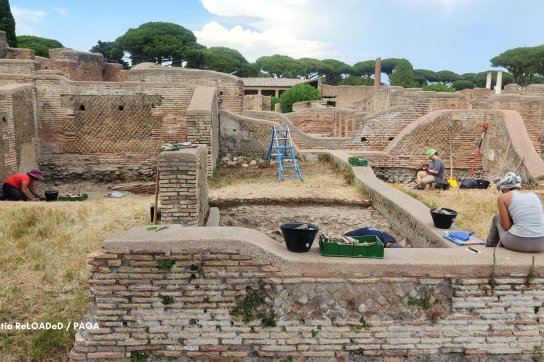
Pedagogy in the field - Archaeological field schools
As part of their training in archaeology, students at the University of Namur experience a unique immersion in their future profession thanks to workcamps. This program, developed by the Department of Archaeology and Art Sciences, closely combines field experience and academic learning.
This article is taken from the "Tomorrow learn" column in the December 2024 issue of Omalius magazine.
This initiative is spearheaded by Fanny Martin, lecturer in national archaeology at UNamur. "Leaving archaeology studies without having experienced the discipline doesn't make much sense. When I arrived, the University of Namur didn't yet have any field schools. It seemed essential to me to offer a project for students, because field archaeology is a discipline in its own right," she explains. Julian Richard, professor of Greek and Roman archaeology and head of the department, adds: "At UNamur, our trump card is to take students out into the field as much as possible. Right from the bachelor's level, they are brought into contact with the object, observing it, manipulating it, understanding it. This is a pedagogy we're keen on, and setting up work-schools is part of it."
During these work-schools, students, confronted with the realities of the field, have to apply their theoretical knowledge to concrete situations, developing not only their technical skills, but also analytical and problem-solving abilities. "In the first and second years, students receive a methodological background on excavation. And then, between their second and third years, they go out on the training site for two weeks and put these principles into practice," adds Fanny Martin.
These internships offer an immersive experience. Bérénice Didier, an art history and archaeology student, worked on the site of Tintigny, an Iron Age tomb necropolis in the Gaume region, while others went to the Feudal castle of Moha, in the Province of Liège.
I got a lot out of this internship. The team on site was lovely. We first learned the basics of excavation, then, little by little, explored all the stages of the discipline, which was exciting", she recounts. Marion Drabbé, a third-year bachelor's student in archaeology, backs up Bérénice's words, adding, "I was a little apprehensive, as the workcamps are like a little exam in our curriculum. But in the end, it was a great experience. We were surrounded by lovely professionals, and I was supervised by Fanny Thirion, archaeologist at the Musée des Celtes. It was great! These workcamps let you see what you're studying, and you realize just how precise and meticulous archaeology is. There's also the satisfaction of discovering previously unseen objects: we found an urn with bone residues and a fibula pin, which is quite rare in excavations. We were delighted!".
The experience of workcamps is not just professional. For Bérénice Didier, it was also a time for sharing and cohesion: "It felt a bit like summer camp. It was really great and I had the opportunity to forge a lot of bonds." Outside digging hours, the students share their daily lives, which fosters strong bonds and develops their ability to work as a team.
These workcamps, which constitute research projects in their own right, require significant organization and varied support. "We chose to work in the Tintigny region, in Gaume. The site is in conservation danger, and we benefit from funding from the Agence wallonne du Patrimoine as well as a partnership with the Musée des Celtes de Libramont and the Commune de Tintigny to carry out the operations. This type of project requires a lot of collaboration to manage the logistics and the study," explains Fanny Martin. What's more, support from partners and UNamur means that internships are free of charge, so that no student is deprived of this opportunity.
A dual mission and an opening onto the professional world
These projects fulfill a dual societal mission: to preserve and pass on heritage to society. With this in mind, students welcome visitors to the site to share their discoveries, enabling them to acquire cultural mediation skills. Bérénice testifies: "Giving guided tours really appealed to me, to the point of making me want to explore this field in the future". Marion adds: "The tours were really enriching. You realize that being able to express your budding knowledge in front of people who are interested in what you're telling them is also very glorifying". This dimension makes these internships much more than mere digs: they are also places of transmission where students value their work to society.
The work sites are also a first experience in the professional world. "They offer them a first baggage for the future", notes Julian Richard. Students can also take part in international missions, such as those organized by Julian Richard in Ostia, the ancient port of Rome, with UCLouvain. These excavations abroad bring a complementary perspective and enrich their training through the study of other contexts, particularly built, as well as other periods.
Thanks to this approach, UNamur archaeology students develop a deeper understanding of their field while building a useful professional network for the future. The workcamp-school becomes a landmark experience, preparing students both academically and personally for the rest of their career.
A new name for the department!
The department was recently renamed the Department of Archaeology and Art Sciences. According to Mathieu Piavaux, a professor at UNamur and former head of the department who contributed to the project, "this change had two objectives. Firstly, to highlight a very practical approach to archaeology, which is strongly emphasised in our teaching approach and in the scientific activity of the department. This is true not only of the courses devoted to archaeological methods and the technology of objects and architecture, but also of the practical work carried out by the students and the courses given in situ. Secondly, we have opted for a name of Germanic origin, “art sciences” (Kunstwissenschaft), which covers a much broader field than art history stricto sensu and is therefore better suited to the diversity of approaches in our disciplines, which include museology and heritage conservation, for example. The new name also reflects the versatility of the department, which is involved in specialised Masters courses in heritage management and conservation. Finally, putting “sciences” in the name is also a nod to the Faculty of Science, with which we regularly collaborate, given the interdisciplinary nature of our disciplines. It all adds up to a great team effort, a great collective dynamic that makes this kind of evolution possible. Redefining ourselves together and developing our identity is always exciting.
This article is taken from the "Tomorrow learn" section of Omalius magazine #35 (December 2024).
Participatory funding: Specularia, experimental archaeology project
The Department of Art History and Archaeology of UNamur is participating for the first time in an experimental archaeology project, within the framework of a doctoral thesis on the production of glass in the Roman period. Conducted in partnership with Malagne, the Rochefort archaeopark, the Specularia project aims to gain a better understanding of the reality of the gestures and techniques of Gallo-Roman craftsmen and to scientifically validate hypotheses that are still debated today. To carry out this experiment, the Department of Art History and Archaeology is launching its first participatory funding.
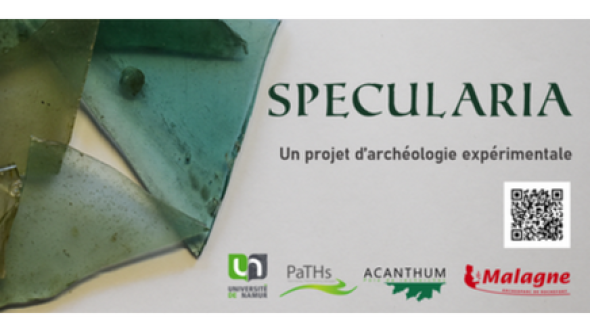
Y avait-il déjà des vitres aux fenêtres au temps des Romains ? La réponse est oui ! Vertes, bleues, jaunes ou incolores, les vitres avaient des formes et des usages variés. La manière dont ce verre à vitre était produit à l'époque romaine continue cependant de faire débat entre les scientifiques. À l'UNamur, les archéologues tentent de percer les secrets de cette production, en partenariat avec des artisans verriers et Malagne, l’archéoparc de Rochefort. Cette expérience s'inscrit dans la thèse de doctorat menée à l’UNamur par Géraldine Frère, sous la direction du professeur Julian Richard.
Chercheuse doctorante, Géraldine Frère étudie depuis 2019 les productions et les usages du verre à vitre entre le 1er et le 5e siècle en Gaule Belgique et en Germanie inférieure, un vaste espace qui correspond à la Belgique actuelle, aux Pays-Bas, au Luxembourg et au nord de la France. Sa recherche est à l’origine du projet Specularia (de specularis, vitres ou fenêtres en latin).
Expérimenter un processus jamais tenté
Le projet entend décrypter les pratiques des artisans romains en recréant deux fours à verre « à l’antique » au sein de l’archéoparc. Le premier sera utilisé pour la fusion du matériau, l’autre pour sa recuisson, deux étapes indispensables de la production du verre. L’expérience sera menée par Géraldine Frère avec l'aide d’artisans verriers (Allain Guillot et "Les infondus") qui utiliseront des techniques et des outils "à la romaine", spécialement conçus sur base d’expérimentations antérieures et des traces retrouvées sur les fragments de vitres antiques. Le verre sera mis en forme suivant un processus inédit et différent de tout ce qui a été testé jusqu’ici : le verre en fusion sera cueilli dans le four, déposé sur une surface avec un cadre chauffée préalablement, puis étiré à l'aide d'outils jusqu'à obtention d'une forme rectangulaire.
Un objectif scientifique et pédagogique
Ce projet permettra aux étudiantes et aux étudiants du Département d’Histoire de l’Art et d’Archéologie de suivre un projet d’archéologie expérimentale en région namuroise. Le public pourra également voir la progression de l’expérience, de la construction des fours dans l’archéoparc au coulage des vitres, avec comme point d’orgue « le Rendez-vous gallo-romain » organisé les 15-16 juillet 2023. Les résultats des expériences seront valorisés scientifiquement dans le cadre du projet de recherche Specularia.
Un financement participatif
Pour mener cette expérience à bien, le Département d’archéologie est à la recherche de 10.000 euros. Cette somme sera intégralement utilisée pour acheter les matériaux permettant de construire les fours et couler le verre (bois, argile, sable, tuiles…) au sein de l'archéoparc et financer le travail des verriers durant la durée de l’expérience (mai-juillet 2023).
Si vous souhaitez faire progresser les connaissances en archéologie gallo-romaine, il vous est possible de rejoindre l’équipe du projet en participant à son financement. Chaque geste de soutien, petit ou grand, sera aussi un encouragement moral à poursuivre ces projets d’innovation en recherche et en enseignement dans le domaine de l’archéologie à l’UNamur !
Soutenez le projet et recevez une contrepartie offerte par Malagne, l’archéoparc de Rochefort
En fonction du montant de votre don, vous débloquerez l'une des contreparties offertes par l’archéoparc (entrées et visites guidées gratuites, participation au week-end gallo-romain…). Rendez-vous sur la page du projet !
Tous les dons à partir de 40 € adressés à l’UNamur, en ligne ou par virement, sont déductibles fiscalement et donnent droit à une réduction d’impôts de 45 %. Un don de 100 € vous coûtera en réalité 55 € après déduction fiscale.
Merci pour votre soutien !