
Bachelor in Law
-
Schedule
regular course
- ECTS Credits 180
You are viewing the program for
Bachelor of Laws, Standard Program |

What is the curriculum for the Bachelor of Laws program at UNamur?
The Bachelor of Laws program at UNamur provides a comprehensive and solid foundation in legal studies, designed to cultivate curious generalist lawyers capable of tackling all areas of law. At UNamur, this program combines theoretical and practical knowledge of the law.
Law Courses: A Comprehensive and Rigorous Foundation
Your program covers the major fields of law:
- Public Law: You will explore the organization of the state and how it functions through courses in constitutional law, sources and principles of law, European Union law, administrative law, criminal law, civil liberties, judicial law, and labor law.
- Private law: You will study the rules governing relationships between individuals through courses in contract law, property law, family law, economic law, intellectual property law, and the history of private law.
- Starting in the first year, a course in legal methodology introduces you to sources of law (both print and digital), the fundamentals of artificial intelligence, legal research, and legal writing.
Interdisciplinary courses: broadening your perspective on society
The Bachelor of Law at UNamur also includes courses in economics, sociology, philosophy, psychology, and history. These courses broaden your general knowledge and strengthen your critical thinking skills, which are essential to any legal analysis. They allow you to better understand the origins and scope of legal rules and to engage in critical reflection on the law.
Electives and options
Build your own path: elective courses & options
Starting in the second block, you can choose a specialization based on your career goals:
- Criminology: You are interested in the study of crime, criminals, and punishment. This track will facilitate your transition to the master’s program in criminology.
- Public Law and Political Science: You are drawn to the study of society, political ideas, the organization of power, the state, its institutions, and how they function.
- Economics and Management: If you choose this track along with additional courses totaling approximately 15 credits, you will be eligible—upon receiving a certificate of supplementary training in economics or management—to enter the Master’s in Economics or the Master’s in Management at UNamur, offered as daytime or evening courses.
- Law and Digital Technology: You wish to enrich your education with a complementary, multidisciplinary approach to digital technology and its implications for fundamental rights (privacy, image, freedom of expression, etc.), criminal law (cyberbullying, cybercrime, etc.), private law (contracts, evidence, property, user protection, etc.), and regulation (artificial intelligence, the sharing economy, etc.).
- Vulnerabilities and Society: You are interested in issues of a more social or societal nature, or you wish to reflect further on how society and the law support individuals facing situations of vulnerability or experiencing multiple vulnerabilities.
- Modern Languages: To strengthen your language skills, you can select advanced courses in Dutch and English related to law.
- Philosophy: You question the ultimate meaning of things and wish to engage with other cultural fields to understand the reality to which the rule of law applies.
- Sustainable Development and Transition: You are interested in exploring the legal aspects of the transition to sustainable development and wish to better understand how this transition shapes and transforms the law of today and tomorrow.
- By adding one or two elective courses to your program and meeting certain requirements, you can, upon receiving a certificate of supplementary training, gain direct admission to UCLouvain’s master’s programs in political science or public administration.
Each track includes an interdisciplinary course and a capstone project. Some tracks facilitate subsequent admission to master’s programs other than the one in law.
You're off to a good start
Language training: an essential asset
In Belgium, a lawyer must be fluent in Dutch and English. These languages are mandatory in your bachelor’s program.
At UNamur, you benefit from:
- diagnostic tests at the beginning of the year,
- refresher modules,
- courses in Dutch legal terminology,
- courses in comparative law and English legal terminology.
- At the end of the program, the UNamur School of Law offers you the opportunity to spend a semester studying abroad at Hasselt University as part of the Erasmus Belgica program. You can also participate in the trilingual immersion program in law.
What teaching methods are used in the Bachelor of Law program at UNamur?
The Bachelor of Law program at UNamur combines theoretical knowledge with practical legal experience through participatory teaching methods. Many of the faculty members are lawyers, judges, public prosecutors, researchers, and others who bring their professional experience to enrich their teaching.
To develop your practical skills, the Faculty of Law has implemented a series of educational initiatives starting in the Bachelor’s program:
- Practice sessions, organized in groups of about twenty students and supervised by a teaching assistant, allow you to delve deeper into specific topics and apply the concepts covered in class. During these sessions, you solve practical cases tailored to your level of study and similar to those faced by lawyers, judges, corporate legal counsel, notaries, and others.
- Writing assignments introduce you to researching legal sources, understanding them, and applying them to develop well-founded, reasoned, and persuasive legal arguments.
- The completion of a capstone project, supervised by a teaching assistant or a legal professional, challenges you with both a substantive issue and a practical case (including meeting with a practicing attorney). As part of their final-year project, some supervised students provide, through the “Namur Legal Lab,” initial legal advice to other students facing issues related to their housing leases.
- An internship is offered at the end of the program. Treated as a full-fledged elective course, it allows you to discover legal practice through observation and participation in certain professional activities carried out by your supervisor (lawyers, judges, notaries, bailiffs, corporate lawyers, lawyers in the nonprofit sector, etc.), under their guidance and with their advice.
- Mock trials in constitutional law or international humanitarian law and a public speaking competition immerse you in the heart of the legal profession.
- Numerous visits to institutions relevant to your future careers as lawyers are offered in Namur (Walloon Parliament, Courthouse, prison) and elsewhere (Parliament, Court of Justice of the European Union, Constitutional Court, Council of State).
For all these activities, attentive and personalized supervision is provided.

What support services are available to help law students succeed?
UNamur helps you develop your academic, methodological, and interpersonal skills—with the support of numerous professionals.
What master’s programs are available after completing a bachelor’s degree in law at UNamur?
A bachelor’s degree in law from UNamur automatically qualifies students for a master’s degree in law in the Wallonia-Brussels Federation. Admission is also possible for master’s programs in law offered in the Flemish Community.
Continuing one’s legal education at another university offers the advantage of experiencing two different campuses, two cultures, and two distinct academic approaches during one’s studies, which is an undeniable asset.
UNamur and UHasselt have developed a trilingual immersion program that guarantees automatic admission to UHasselt’s Master’s program. Specific agreements have also been established with KULeuven and UAntwerpen to facilitate admission to their Master’s programs.
Master’s in Criminology
A Bachelor’s degree in Law also grants access to the Master’s in Criminology with program adjustments.
Additional programs leading to other master’s degrees
A dual bachelor’s degree in law and philosophy, completed in four years, will grant you access to the corresponding master’s programs.
In addition, the Faculty offers specialized programs whose certificates allow you to enter the Master’s programs
- in Management Sciences (daytime and evening programs at UNamur),
- in Economics (daytime and evening programs) (at UNamur and UCLouvain),
- in political science or public administration (at UCLouvain)
FAQ - Frequently Asked Questions About the Bachelor of Laws Program at UNamur
What is the Bachelor of Laws program at UNamur?
The Bachelor of Law at UNamur is a 180-credit university program that covers all the fundamental subjects of public and private law, as well as interdisciplinary courses designed to develop critical thinking and a broad understanding of the humanities and social sciences.
What areas are covered in this program?
You will study both public law (constitutional, administrative, European Union law, labor law, etc.) and private law (contracts, property, family law, business law, intellectual property law). In addition, courses in economics, sociology, and psychology will enrich your overall understanding of the law.
Does the Bachelor of Law program include language courses?
Yes. Knowledge of Dutch and English is essential. The program includes courses in legal terminology in these languages as well as personalized academic support (diagnostic tests and remedial instruction) to help you read and understand contracts or court decisions in English and Dutch. If you wish, you can also take more interactive courses.
What electives can I choose during the bachelor’s program?
You can choose electives such as criminology, law and digital technology, economics and management, modern languages, philosophy, vulnerabilities and societies, sustainable development, or public law and political science, depending on your interests and academic plans.
What teaching methods are used?
The bachelor’s program combines theory and practice through lectures, seminars, mock trials, a public speaking competition, visits to institutions (Walloon Parliament, Courthouse, etc.), interactive exercises, and small-group instruction.
Can I do an internship during the bachelor’s program?
Yes. A legal internship is offered at the end of the program. It takes place under the supervision of a professional (lawyer, judge, notary, bailiff, or corporate lawyer) and allows you to gain hands-on experience in legal professions.
What career opportunities are available after the Bachelor’s in Law?
The Bachelor’s degree in Law provides access to Master’s programs in Law offered by institutions in the Wallonia-Brussels Federation and the Flemish Community. It also allows you to pursue a Master’s in Criminology or Master’s degrees in related fields with certain supplementary courses.
What skills will I acquire with this bachelor’s degree?
By the end of the bachelor’s program, you will be able to understand the main concepts of Belgian and European law, conduct legal research, analyze real-world situations, and communicate legal arguments clearly both orally and in writing.
Vous consultez le programme de
Bachelier en droit, double bac droit-philosophie |

The Bachelor of Law program at UNamur offers you a comprehensive basic legal education, aimed at making you excellent general lawyers.
Your training in law during the bachelor's course covers the rules organizing the State and its action ("public law"): constitutional law, sources and principles of law, European Union law, administrative law, criminal law, public liberties, judicial law, social law... as well as the norms governing relations between individuals ("private law"): law of obligations, property law, family law, economic law, intellectual rights, history of private law... These lessons are complemented by a legal methodology course that introduces you to documentary sources in print and online (legislation, case law, doctrine), research and personal writing assignments.
Parallel to the legal courses, other courses develop your open-mindedness and general culture (economics, sociology, history of Belgian institutions, psychology...). They enable you to better understand the genesis and scope of rules, as well as to think critically about the law.
Some sources of law are only available in English or Dutch. Knowledge of these languages is therefore essential for any Belgian lawyer, and teaching them is a compulsory part of your training. However, you will benefit from specific pedagogical support (diagnostic test at the beginning of the year and, if necessary, guidance towards a refresher module).
Following the legal language courses, you will be introduced to the legal vocabulary of these two languages (courses in "Dutch legal terminology" and "comparative law and English legal terminology"). These courses enable you to read and understand a contract, a judgment or a legal study in these languages...
Finally, you complete your program with courses of your choice in legal and/or non-legal subjects depending on your personal project. You can group these courses around an option (criminology, vulnerabilities and societies, public law and political science, economics and management, law and digital, philosophy, modern languages, sustainable development) which also includes an interdisciplinary course and the end-of-cycle assignment. Some of these options facilitate subsequent access to certain masters degrees other than law.
At the end of the cycle, you have the option of taking a four-quarter course at Hasselt University as part of the Erasmus Belgica program. You can also follow the trilingual program.
Electives and options
From the second annual block onwards, the Faculty of Law offers you the opportunity to acquire specific training in a legal field or law-related discipline:
- Criminology: if you are interested in the study of crime, the criminal and punishment (juvenile delinquency, sexual offences, reactions to insecurity, figures of the individual and contemporary individualism...). This option will facilitate your transition to the master's degree in criminology.
- Public Law and Political Science: if you are attracted to the study of society, political ideas, the organization of powers, the State, its institutions and how they function. By adding one or two courses of your choice to your program and meeting certain conditions, you can, under the benefit of an attestation of complementary training, gain direct access to UCLouvain's Masters in Political Science or Public Administration.
- Economics and Management: if you choose this option and additional courses of the order of 15 credits, you will be able to access, under the benefit of an attestation of complementary training in economics or complementary training in management, to the master in economics or to the master in management sciences of UNamur, organized in daytime classes and at staggered timetable.
- Law and Digital: if you wish to enrich your training with a complementary and multidisciplinary approach around digital and its issues in terms of fundamental rights (privacy, image, freedom of expression...), criminal law (cyberharassment, cybercrime...)..., private law (contracts, evidence, property, user protection...) and regulation (artificial intelligence, shared economy...).
- Vulnerabilities and societies: if you're interested in issues of a more social or societal nature, or if you'd like to think more about how society, particularly through the legal tool, supports (or not) individuals facing a situation of vulnerability or experiencing multiple vulnerabilities.
- Modern languages: to strengthen your language skills, you can select advanced law-related courses in Dutch and English. An introduction to Belgian German legal terminology is also offered (course taught in French).
- Philosophy: if you wonder about the ultimate why of things and wish to dialogue with other areas of culture to understand reality (to which the rule of law applies).
- Sustainable development and transition: if you're interested in exploring the legal aspects of the transition to sustainable development (in its environmental, social and economic dimensions) and want to better understand how the transition to sustainable development is guiding and transforming the law of today and tomorrow.
You're off to a good start
- you enjoy expressing yourself in writing or orally, reading and understanding text;
- you are curious about the world in which you live;
- you have an analytical and critical mind;
- you are inventive and able to imagine new solutions and argue in favor of them.
Law bachelor training will help you further develop these qualities.
Teaching methods
The courses offer a comprehensive approach. They combine theoretical knowledge with a practical perspective on the law, using participatory methods and involving legal practitioners. In fact, many teachers are lawyers, judges, researchers...... and enrich their teaching with their experience.
In addition, you have the opportunity to develop your practical skills through exercises, assignments, mock trials, an eloquence tournament, an internship and the "Namur Legal Lab".
Organized in groups of around twenty students and supervised by an assistant, the exercise sessions enable you to delve deeper into part of the subject matter and put into practice the notions seen in class (documents to read and exercises to prepare in advance). During these sessions, you solve practical cases adapted to your level of study and similar to those faced by lawyers, judges, in-house counsel, notaries... You also develop the art of discussion and expression, in public, of rigorous thought.
By writing papers on a legal topic, you learn to find the sources of the law (in codes, library books, properly targeted internet sources...), understand and exploit them by developing a well-founded, argued and convincing legal reasoning. In the second annual block, you will complete a project designed to put into practice what you have learned in the legal methodology course. Individual and small-group support (between 8 and 15 students) is provided by an assistant who supervises and corrects each stage of this work.
Assisted by an assistant, you then complete an end-of-cycle assignment that confronts you with both a substantive question and a practical case (including meeting a practitioner). In this assignment, you will apply all the theoretical and practical skills you have acquired. On the occasion of the end-of-cycle work, some supervised students provide, within the framework of the "Namur Legal Lab", initial legal advice to other students who encounter problems concerning the rental of their accommodation.
You take part in mock trials in constitutional law or international humanitarian law. In addition, a tournament of eloquence is organized each year within the Faculty. Numerous visits to institutions, linked to your path as future jurists, are offered in Namur (Walloon Parliament, Palais de Justice, prison establishment) and elsewhere (Parliament, Court of Justice of the European Union, Constitutional Court, Council of State).
At the end of the cycle, the Faculty organizes a legal practice internship. This internship, which is treated as an elective course in its own right, enables you to discover legal practice through activities essentially involving observation and participation in certain parts of the professional activities carried out by your internship supervisor (lawyers, magistrates, notaries, bailiffs, company lawyers, lawyers in the associative sector...), under his or her guidance and with his or her advice.
For all these activities, attentive, tailor-made supervision is organized.

Success aids
Succeeding in a year of study at university involves many challenges.
To help you meet them, UNamur supports you in developing your disciplinary, methodological and human skills... with the support of numerous professionals.
After the baccalauréat: the master's degree
The bachelor's degree in law gives automatic access to the master's degree in law (two years) in the Wallonia-Brussels Federation and the Flemish Community.
UNamur and UHasselt have drawn up the trilingual program which guarantees automatic access to the UHasselt master's degree. Specific agreements have also been signed with KULeuven and UAntwerpen to facilitate access to their masters programs.Continuing your law studies at another university offers the advantage of getting to know two different sites, two different cultures and two different academic ways of thinking during your studies, which is an undeniable asset.
The bachelor's degree in law also gives access to the master's degree in criminology with program adaptation.
Furthermore, the Faculty organizes two complementary courses whose attestations give you access to master's degrees in management sciences at daytime and to shifted time (at UNamur), in economics at daylight saving time and at staggered schedule (at UNamur and UCLouvain), in political science or public administration (at UCLouvain).
A double bachelor's degree in law and philosophy to be completed over four years will give you access to the two corresponding master's degrees.
Vous consultez le programme de
Bachelier en droit, programme Erasmus Belgica avec l'UHasselt |

The Bachelor of Law program at UNamur offers you a comprehensive basic legal education, aimed at making you excellent general lawyers.
Your training in law during the bachelor's course covers the rules organizing the State and its action ("public law"): constitutional law, sources and principles of law, European Union law, administrative law, criminal law, public liberties, judicial law, social law... as well as the norms governing relations between individuals ("private law"): law of obligations, property law, family law, economic law, intellectual rights, history of private law... These lessons are complemented by a legal methodology course that introduces you to documentary sources in print and online (legislation, case law, doctrine), research and personal writing assignments.
Parallel to the legal courses, other courses develop your open-mindedness and general culture (economics, sociology, history of Belgian institutions, psychology...). They enable you to better understand the genesis and scope of rules, as well as to think critically about the law.
Some sources of law are only available in English or Dutch. Knowledge of these languages is therefore essential for any Belgian lawyer, and teaching them is a compulsory part of your training. However, you will benefit from specific pedagogical support (diagnostic test at the beginning of the year and, if necessary, guidance towards a refresher module).
Following the legal language courses, you will be introduced to the legal vocabulary of these two languages (courses in "Dutch legal terminology" and "comparative law and English legal terminology"). These courses enable you to read and understand a contract, a judgment or a legal study in these languages...
Finally, you complete your program with courses of your choice in legal and/or non-legal subjects depending on your personal project. You can group these courses around an option (criminology, vulnerabilities and societies, public law and political science, economics and management, law and digital, philosophy, modern languages, sustainable development) which also includes an interdisciplinary course and the end-of-cycle assignment. Some of these options facilitate subsequent access to certain masters degrees other than law.
At the end of the cycle, you have the option of taking a four-quarter course at Hasselt University as part of the Erasmus Belgica program. You can also follow the trilingual program.
Electives and options
From the second annual block onwards, the Faculty of Law offers you the opportunity to acquire specific training in a legal field or law-related discipline:
- Criminology: if you are interested in the study of crime, the criminal and punishment (juvenile delinquency, sexual offences, reactions to insecurity, figures of the individual and contemporary individualism...). This option will facilitate your transition to the master's degree in criminology.
- Public Law and Political Science: if you are attracted to the study of society, political ideas, the organization of powers, the State, its institutions and how they function. By adding one or two courses of your choice to your program and meeting certain conditions, you can, under the benefit of an attestation of complementary training, gain direct access to UCLouvain's Masters in Political Science or Public Administration.
- Economics and Management: if you choose this option and additional courses of the order of 15 credits, you will be able to access, under the benefit of an attestation of complementary training in economics or complementary training in management, to the master in economics or to the master in management sciences of UNamur, organized in daytime classes and at staggered timetable.
- Law and Digital: if you wish to enrich your training with a complementary and multidisciplinary approach around digital and its issues in terms of fundamental rights (privacy, image, freedom of expression...), criminal law (cyberharassment, cybercrime...)..., private law (contracts, evidence, property, user protection...) and regulation (artificial intelligence, shared economy...).
- Vulnerabilities and societies: if you're interested in issues of a more social or societal nature, or if you'd like to think more about how society, particularly through the legal tool, supports (or not) individuals facing a situation of vulnerability or experiencing multiple vulnerabilities.
- Modern languages: to strengthen your language skills, you can select advanced law-related courses in Dutch and English. An introduction to Belgian German legal terminology is also offered (course taught in French).
- Philosophy: if you wonder about the ultimate why of things and wish to dialogue with other areas of culture to understand reality (to which the rule of law applies).
- Sustainable development and transition: if you're interested in exploring the legal aspects of the transition to sustainable development (in its environmental, social and economic dimensions) and want to better understand how the transition to sustainable development is guiding and transforming the law of today and tomorrow.
You're off to a good start
- you enjoy expressing yourself in writing or orally, reading and understanding text;
- you are curious about the world in which you live;
- you have an analytical and critical mind;
- you are inventive and able to imagine new solutions and argue in favor of them.
Law bachelor training will help you further develop these qualities.
Teaching methods
The courses offer a comprehensive approach. They combine theoretical knowledge with a practical perspective on the law, using participatory methods and involving legal practitioners. In fact, many teachers are lawyers, judges, researchers...... and enrich their teaching with their experience.
In addition, you have the opportunity to develop your practical skills through exercises, assignments, mock trials, an eloquence tournament, an internship and the "Namur Legal Lab".
Organized in groups of around twenty students and supervised by an assistant, the exercise sessions enable you to delve deeper into part of the subject matter and put into practice the notions seen in class (documents to read and exercises to prepare in advance). During these sessions, you solve practical cases adapted to your level of study and similar to those faced by lawyers, judges, in-house counsel, notaries... You also develop the art of discussion and expression, in public, of rigorous thought.
By writing papers on a legal topic, you learn to find the sources of the law (in codes, library books, properly targeted internet sources...), understand and exploit them by developing a well-founded, argued and convincing legal reasoning. In the second annual block, you will complete a project designed to put into practice what you have learned in the legal methodology course. Individual and small-group support (between 8 and 15 students) is provided by an assistant who supervises and corrects each stage of this work.
Assisted by an assistant, you then complete an end-of-cycle assignment that confronts you with both a substantive question and a practical case (including meeting a practitioner). In this assignment, you will apply all the theoretical and practical skills you have acquired. On the occasion of the end-of-cycle work, some supervised students provide, within the framework of the "Namur Legal Lab", initial legal advice to other students who encounter problems concerning the rental of their accommodation.
You take part in mock trials in constitutional law or international humanitarian law. In addition, a tournament of eloquence is organized each year within the Faculty. Numerous visits to institutions, linked to your path as future jurists, are offered in Namur (Walloon Parliament, Palais de Justice, prison establishment) and elsewhere (Parliament, Court of Justice of the European Union, Constitutional Court, Council of State).
At the end of the cycle, the Faculty organizes a legal practice internship. This internship, which is treated as an elective course in its own right, enables you to discover legal practice through activities essentially involving observation and participation in certain parts of the professional activities carried out by your internship supervisor (lawyers, magistrates, notaries, bailiffs, company lawyers, lawyers in the associative sector...), under his or her guidance and with his or her advice.
For all these activities, attentive, tailor-made supervision is organized.
Success aids
Succeeding in a year of study at university involves many challenges.
To help you meet them, UNamur supports you in developing your disciplinary, methodological and human skills... with the support of numerous professionals.
After the baccalauréat: the master's degree
The bachelor's degree in law gives automatic access to the master's degree in law (two years) in the Wallonia-Brussels Federation and the Flemish Community.
UNamur and UHasselt have drawn up the trilingual program which guarantees automatic access to the UHasselt master's degree. Specific agreements have also been signed with KULeuven and UAntwerpen to facilitate access to their masters programs.Continuing your law studies at another university offers the advantage of getting to know two different sites, two different cultures and two different academic ways of thinking during your studies, which is an undeniable asset.
The bachelor's degree in law also gives access to the master's degree in criminology with program adaptation.
Furthermore, the Faculty organizes two complementary courses whose attestations give you access to master's degrees in management sciences at daytime and to shifted time (at UNamur), in economics at daylight saving time and at staggered schedule (at UNamur and UCLouvain), in political science or public administration (at UCLouvain).
A double bachelor's degree in law and philosophy to be completed over four years will give you access to the two corresponding master's degrees.
Vous consultez le programme de
Bachelier en droit, programme trilingue "2+2+1" |

The Bachelor of Law program at UNamur offers you a comprehensive basic legal education, aimed at making you excellent general lawyers.
Your training in law during the bachelor's course covers the rules organizing the State and its action ("public law"): constitutional law, sources and principles of law, European Union law, administrative law, criminal law, public liberties, judicial law, social law... as well as the norms governing relations between individuals ("private law"): law of obligations, property law, family law, economic law, intellectual rights, history of private law... These lessons are complemented by a legal methodology course that introduces you to documentary sources in print and online (legislation, case law, doctrine), research and personal writing assignments.
Parallel to the legal courses, other courses develop your open-mindedness and general culture (economics, sociology, history of Belgian institutions, psychology...). They enable you to better understand the genesis and scope of rules, as well as to think critically about the law.
Some sources of law are only available in English or Dutch. Knowledge of these languages is therefore essential for any Belgian lawyer, and teaching them is a compulsory part of your training. However, you will benefit from specific pedagogical support (diagnostic test at the beginning of the year and, if necessary, guidance towards a refresher module).
Following the legal language courses, you will be introduced to the legal vocabulary of these two languages (courses in "Dutch legal terminology" and "comparative law and English legal terminology"). These courses enable you to read and understand a contract, a judgment or a legal study in these languages...
Finally, you complete your program with courses of your choice in legal and/or non-legal subjects depending on your personal project. You can group these courses around an option (criminology, vulnerabilities and societies, public law and political science, economics and management, law and digital, philosophy, modern languages, sustainable development) which also includes an interdisciplinary course and the end-of-cycle assignment. Some of these options facilitate subsequent access to certain masters degrees other than law.
At the end of the cycle, you have the option of taking a four-quarter course at Hasselt University as part of the Erasmus Belgica program. You can also follow the trilingual program.
Electives and options
From the second annual block onwards, the Faculty of Law offers you the opportunity to acquire specific training in a legal field or law-related discipline:
- Criminology: if you are interested in the study of crime, the criminal and punishment (juvenile delinquency, sexual offences, reactions to insecurity, figures of the individual and contemporary individualism...). This option will facilitate your transition to the master's degree in criminology.
- Public Law and Political Science: if you are attracted to the study of society, political ideas, the organization of powers, the State, its institutions and how they function. By adding one or two courses of your choice to your program and meeting certain conditions, you can, under the benefit of an attestation of complementary training, gain direct access to UCLouvain's Masters in Political Science or Public Administration.
- Economics and Management: if you choose this option and additional courses of the order of 15 credits, you will be able to access, under the benefit of an attestation of complementary training in economics or complementary training in management, to the master in economics or to the master in management sciences of UNamur, organized in daytime classes and at staggered timetable.
- Law and Digital: if you wish to enrich your training with a complementary and multidisciplinary approach around digital and its issues in terms of fundamental rights (privacy, image, freedom of expression...), criminal law (cyberharassment, cybercrime...)..., private law (contracts, evidence, property, user protection...) and regulation (artificial intelligence, shared economy...).
- Vulnerabilities and societies: if you're interested in issues of a more social or societal nature, or if you'd like to think more about how society, particularly through the legal tool, supports (or not) individuals facing a situation of vulnerability or experiencing multiple vulnerabilities.
- Modern languages: to strengthen your language skills, you can select advanced law-related courses in Dutch and English. An introduction to Belgian German legal terminology is also offered (course taught in French).
- Philosophy: if you wonder about the ultimate why of things and wish to dialogue with other areas of culture to understand reality (to which the rule of law applies).
- Sustainable development and transition: if you're interested in exploring the legal aspects of the transition to sustainable development (in its environmental, social and economic dimensions) and want to better understand how the transition to sustainable development is guiding and transforming the law of today and tomorrow.
You're off to a good start
- you enjoy expressing yourself in writing or orally, reading and understanding text;
- you are curious about the world in which you live;
- you have an analytical and critical mind;
- you are inventive and able to imagine new solutions and argue in favor of them.
Law bachelor training will help you further develop these qualities.
Teaching methods
The courses offer a comprehensive approach. They combine theoretical knowledge with a practical perspective on the law, using participatory methods and involving legal practitioners. In fact, many teachers are lawyers, judges, researchers...... and enrich their teaching with their experience.
In addition, you have the opportunity to develop your practical skills through exercises, assignments, mock trials, an eloquence tournament, an internship and the "Namur Legal Lab".
Organized in groups of around twenty students and supervised by an assistant, the exercise sessions enable you to delve deeper into part of the subject matter and put into practice the notions seen in class (documents to read and exercises to prepare in advance). During these sessions, you solve practical cases adapted to your level of study and similar to those faced by lawyers, judges, in-house counsel, notaries... You also develop the art of discussion and expression, in public, of rigorous thought.
By writing papers on a legal topic, you learn to find the sources of the law (in codes, library books, properly targeted internet sources...), understand and exploit them by developing a well-founded, argued and convincing legal reasoning. In the second annual block, you will complete a project designed to put into practice what you have learned in the legal methodology course. Individual and small-group support (between 8 and 15 students) is provided by an assistant who supervises and corrects each stage of this work.
Assisted by an assistant, you then complete an end-of-cycle assignment that confronts you with both a substantive question and a practical case (including meeting a practitioner). In this assignment, you will apply all the theoretical and practical skills you have acquired. On the occasion of the end-of-cycle work, some supervised students provide, within the framework of the "Namur Legal Lab", initial legal advice to other students who encounter problems concerning the rental of their accommodation.
You take part in mock trials in constitutional law or international humanitarian law. In addition, a tournament of eloquence is organized each year within the Faculty. Numerous visits to institutions, linked to your path as future jurists, are offered in Namur (Walloon Parliament, Palais de Justice, prison establishment) and elsewhere (Parliament, Court of Justice of the European Union, Constitutional Court, Council of State).
At the end of the cycle, the Faculty organizes a legal practice internship. This internship, which is treated as an elective course in its own right, enables you to discover legal practice through activities essentially involving observation and participation in certain parts of the professional activities carried out by your internship supervisor (lawyers, magistrates, notaries, bailiffs, company lawyers, lawyers in the associative sector...), under his or her guidance and with his or her advice.
For all these activities, attentive, tailor-made supervision is organized.
Success aids
Succeeding in a year of study at university involves many challenges.
To help you meet them, UNamur supports you in developing your disciplinary, methodological and human skills... with the support of numerous professionals.
After the baccalauréat: the master's degree
The bachelor's degree in law gives automatic access to the master's degree in law (two years) in the Wallonia-Brussels Federation and the Flemish Community.
UNamur and UHasselt have drawn up the trilingual program which guarantees automatic access to the UHasselt master's degree. Specific agreements have also been signed with KULeuven and UAntwerpen to facilitate access to their masters programs.Continuing your law studies at another university offers the advantage of getting to know two different sites, two different cultures and two different academic ways of thinking during your studies, which is an undeniable asset.
The bachelor's degree in law also gives access to the master's degree in criminology with program adaptation.
Furthermore, the Faculty organizes two complementary courses whose attestations give you access to master's degrees in management sciences at daytime and to shifted time (at UNamur), in economics at daylight saving time and at staggered schedule (at UNamur and UCLouvain), in political science or public administration (at UCLouvain).
A double bachelor's degree in law and philosophy to be completed over four years will give you access to the two corresponding master's degrees.
-
Law
Code Name Staff Th.+Ex. Credits/Block 1 2 3 DROIB105 Historical foundations of private law 90h th. + 8h ex. 9 DROIB102 Constitutional law Vuye Hendrik 75h th. + 6h ex. 9 Sustainable developmentImage Soft skillsImage
DROIB101 Sources and principles of law Degrave Élise 60h th. + 15h ex. 8 DROIB103 Law of obligations I George Florence 45h th. + 15h ex. 6 Sustainable developmentImage
Soft skillsImage
DROIB214 Criminal law Basecqz Nathalie 75h th. + 15h ex. 8 DROIB210 EU Institutional law De Streel Alexandre 45h th. 5 DROIB216 Principles of civil procedure 45h th. + 6h ex. 5 DROIB211 Law of obligations II Colson Pauline George Florence 75h th. + 15h ex. 8 DROIB213 Methodology and legal work De Terwangne Cécile 30h th. + 30h ex. 6 Translated with DeepL.com (free version)Soft skillsImage
DROIB212 Family law Mathieu Géraldine 60h th. + 8h ex. 6 DROIB316 Intellectual Property Rights Desaunettes Luc 30h th. 3 DROIB318 Administrative law Nihoul Marc 60h th. + 6h ex. 6 DROIB317 Social law Flohimont Valérie 45h th. + 8h ex. 4 DROIB312 Public liberties Vuye Hendrik 30h th. + 5h ex. 4 DROIB311 Criminal procedure Basecqz Nathalie 30h th. 3 Sustainable developmentImage
Soft skillsImage
DROIB314 Economic law Jacquemin Hervé 60h th. + 6h ex. 6 Sustainable developmentImage
Soft skillsImage
DROIB310 Comparative law and English legal terminology Lachapelle Amélie Lachapelle Amélie 45h th. + 6h ex. 6 DROIB313 Property Law 30h th. 3 DROIB315 Special contract law 30h th. 3 -
Humanities
Code Name Staff Th.+Ex. Credits/Block 1 2 3 DROIB154 Political economy Cheffert Jean-Marie 60h th. + 15h ex. 7 Soft skillsImage
DROIB152 Constitutional history and political systems 45h th. + 6h ex. 5 Soft skillsImage
DROIB153 History of the Belgian institutions Tixhon Axel 30h th. 3 DROIB132 Introduction to philosophy De Meyer Thibault Rizzerio Laura Rizzerio Laura 45h th. 5 DROIB150 Psychology and introduction to criminology Brackelaire Jean-Luc 45h th. 5 DROIB243 Sociology 30h th. 3 DROIB242 Foundations of ethics Longneaux Jean-Michel 30h th. 3 DROIB244 Logic and argumentation De Meyer Thibault 45h th. 4 DROIB240 Religious Studies 30h th. 3 DROIB320 Philosophy of law Montero Redondo Etienne 45h th. 4 -
Languages
Code Name Staff Th.+Ex. Credits/Block 1 2 3 DCDLB101 Standard Dutch Bulon Amélie 30h th. 3 DCDLB201 English for Legal Professionals (level B2) Hansel Aude 30h th. 3 -
Dutch
Code Name Staff Th.+Ex. Credits/Block 1 2 3 DROIB221 Dutch legal terminology - advanced level Cassiers Aurélie 30h th. 3 DROIB218 Dutch legal terminology (minimum level B2) Cassiers Aurélie 30h th. 3
-
-
Option
-
Economics and management
-
Compulsory courses
Code Name Staff Th.+Ex. Credits/Block 1 2 3 DROIB322 Economic foundations of regulation Cheffert Jean-Marie 30h th. 4 Soft skillsImage
DROIB393 End of cycle work of the "Economics and Management" option Defreyne Élise 30h ex. 5 -
Choice of courses
Code Name Staff Th.+Ex. Credits/Block 1 2 3 ECGEB284 Marketing Management Decrop Alain 30h th. + 30h ex. 5 5 ECGEB270 Macroeconomics Kiedaisch Christian 45h th. + 15h ex. 5 5 English Friendly CoursesImage
EFASB357 Macroeconomics Kiedaisch Christian 45h th. 7 7 ECGEB151 Mathematics for Economic Analysis I Libert Anne-Sophie 30h th. + 22.5h ex. 5 5 EFASB231 General mathematics 30h th. + 15h ex. 5 5 EFASB354 Financial and cost accounting 45h th. 7 7 ECGEB180 Fundamentals of management Zidda Pietro 45h th. + 15h ex. 5 5 ECGEB110 Data Organization and Processing 30h th. + 15h ex. 4 4 Sustainable developmentImage
ECONB311 Environmental economics Baland Jean-Marie 30h th. + 15h ex. 5 ECONB313 Economy and AI: Transformations and challenges Hungerbuhler Mathias 45h th. 5 EFASB255 Industrial economics Toulemonde Éric 30h th. 5 ECGEB261 Microeconomics Guirkinger Catherine 45h th. + 15h ex. 5 EFASB250 Microeconomics Decerf Benoît 45h th. 7 ECGEB383_autres Finance 45h th. + 15h ex. 5
-
-
Vulnerabilities and societies
-
Compulsory courses
Code Name Staff Th.+Ex. Credits/Block 1 2 3 DROIB324 Public law and political science Nihoul Marc 30h th. 4 Soft skillsImage
DROIB397 Final paper of the "Vulnerabilities and Societies" option Defreyne Élise 30h ex. 5 -
Choice of courses
Code Name Staff Th.+Ex. Credits/Block 1 2 3 SSPSB101 Philosophical questions Sartenaer Olivier 22h th. + 7h ex. 2 2 LPHIB203 Social and political philosophy Laoureux Sébastien 30h th. 3 3 Translated with DeepL.com (free version)Soft skillsImage
DROIB220 Youth law Mathieu Géraldine 30h th. 3 3 SSPSB202 History of science Sartenaer Olivier 22.5h th. 2 2 LPHIB206_30h <unknown> Monseu-Van Cleemput Nicolas 30h th. 3 3 Sustainable developmentImage
ECONB311 Environmental economics Baland Jean-Marie 30h th. + 15h ex. 5 Sustainable developmentImage
Soft skillsImage
SGOGB309 Geography of the population Henry Sabine 30h th. + 23h ex. 4 DGENM301 Law, gender and society Wattier Stéphanie 30h th. 5 DROIB338 Anti-discrimination law Flohimont Valérie 30h th. 3 Sustainable developmentImage
DROIB336 Special welfare issues at work Flohimont Valérie 30h th. 3 MMEDB306_Droit Public health Ravez Laurent Roberfroid Dominique 20h th. 2
-
-
Modern languages
-
Compulsory courses
Code Name Staff Th.+Ex. Credits/Block 1 2 3 DROIB340 Legal practice in Dutch 30h th. 4 DROIB335 Legal Culture of the English Speaking World Wattier Stéphanie 30h th. 4 Soft skillsImage
English Friendly CoursesImage
DROIB394 End of cycle work for the "modern languages" option Defreyne Élise 30h ex. 5 -
Choice of courses
-
-
Sustainable development and transition
-
Compulsory courses
Code Name Staff Th.+Ex. Credits/Block 1 2 3 Sustainable developmentImage
Soft skillsImage
DROIB330 Environmental law and sustainable development Lachapelle Amélie 30h th. 4 4 Soft skillsImage
DROIB325 Ethics and Law 30h th. 4 Sustainable developmentImage
DROIB398 Final dissertation on the "Sustainable development and transition" option Defreyne Élise 30h ex. 5 -
Choice of courses
Code Name Staff Th.+Ex. Credits/Block 1 2 3 Sustainable developmentImage
Soft skillsImage
UNAM0047 Law, sustainable development and transition 24h th. 3 3 Sustainable developmentImage
UNAM0043 Global change and the Anthropocene Yans Johan Dendoncker Nicolas Yans Johan Linard Catherine Houssiau Laurent Henry Sabine 24h th. 3 3 INFOB115 Technology, science and us Ferry-Danini Juliette 30h th. 3 3 Sustainable developmentImage
LPHIB103 Philosophical and ecologies anthropology Laoureux Sébastien De Meyer Thibault 45h th. 5 5 Sustainable developmentImage
Soft skillsImage
UNAM0055 JEDDT 18h th. + 16h ex. 3 3 Sustainable developmentImage
ECONB311 Environmental economics Baland Jean-Marie 30h th. + 15h ex. 5 Sustainable developmentImage
DROIB336 Special welfare issues at work Flohimont Valérie 30h th. 3 DGENM301 Law, gender and society Wattier Stéphanie 30h th. 5
-
-
Public law and political science
-
Compulsory courses
Code Name Staff Th.+Ex. Credits/Block 1 2 3 DROIB324 Public law and political science Nihoul Marc 30h th. 4 Soft skillsImage
DROIB392 Final paper of the "public law and political science" option Defreyne Élise 30h ex. 5 -
Choice of courses
-
-
Criminology
-
Choice of courses
Code Name Staff Th.+Ex. Credits/Block 1 2 3 DROIB328 Clinical approaches in criminology 30h th. 3 3 EFASB332 Statistics and probability Baland Jean-Marie 30h th. + 15h ex. 7 7 Translated with DeepL.com (free version)Soft skillsImage
DROIB220 Youth law Mathieu Géraldine 30h th. 3 3 LPHIB212 Ethnology Brackelaire Jean-Luc 30h th. 3 3 -
Compulsory courses
Code Name Staff Th.+Ex. Credits/Block 1 2 3 DROIB326 Main trends in criminology Tixhon Axel 30h th. 4 Soft skillsImage
DROIB391 Final paper of the "criminology" option Defreyne Élise 30h ex. 5
-
-
Digital law
-
Compulsory courses
Code Name Staff Th.+Ex. Credits/Block 1 2 3 DROIB329 Digital, fundamental rights and cybercrime De Terwangne Cécile 30h th. 3 Soft skillsImage
DROIB396 End of cycle work of the "Law and Digital" option Defreyne Élise 30h ex. 5 Sustainable developmentImage
Translated with DeepL.com (free version)Soft skillsImage
DROIB333 Regulation and technological innovations Degrave Élise 30h th. 4 DROIB339 Digital and private law 30h th. 3 -
Choice of courses
Code Name Staff Th.+Ex. Credits/Block 1 2 3 DROIB219 Computer Science and Law 30h th. 3 3 EINCB213 Actors, structures, and networks in the digital age Barnabé Fanny 30h th. + 15h ex. 3 3 LPHIB305_prêté Ethical issues applied to the digital environment Rouvroy Antoinette 15h th. 3
-
-
Philosophy
-
Compulsory courses
Code Name Staff Th.+Ex. Credits/Block 1 2 3 Soft skillsImage
DROIB325 Ethics and Law 30h th. 4 Soft skillsImage
DROIB395 End of cycle work of the "philosophy" option Defreyne Élise 30h ex. 5 -
Choice of courses
Code Name Staff Th.+Ex. Credits/Block 1 2 3 LPHIB201 General epistemology De Meyer Thibault 30h th. 3 3 LPHIB207 Philosophy of art and Culture Rizzerio Laura 30h th. 3 3 LPHIB203 Social and political philosophy Laoureux Sébastien 30h th. 3 3 LPHIB005_Textes History and Texts of Ancient Philosophy - Partim Texts 15h ex. 3 3 LPHIB006_Textes History and Texts of Medieval Philosophy - Partim Texts 15h ex. 3 3 LPHIB007_Textes History and Texts of Early Modern Philosophy - Partim Texts Laoureux Sébastien 15h ex. 3 3 LPHIB008_Textes History and Texts of Contemporary Philosophy - Partim Texts 15h ex. 3 3
-
-
-
A la carte training
-
Interdisciplinary courses
Code Name Staff Th.+Ex. Credits/Block 1 2 3 DROIB340 Legal practice in Dutch 30h th. 4 DROIB335 Legal Culture of the English Speaking World Wattier Stéphanie 30h th. 4 DROIB322 Economic foundations of regulation Cheffert Jean-Marie 30h th. 4 DROIB326 Main trends in criminology Tixhon Axel 30h th. 4 DROIB324 Public law and political science Nihoul Marc 30h th. 4 Soft skillsImage
DROIB325 Ethics and Law 30h th. 4 Sustainable developmentImage
Translated with DeepL.com (free version)Soft skillsImage
DROIB333 Regulation and technological innovations Degrave Élise 30h th. 4 -
End-of-cycle work
Code Name Staff Th.+Ex. Credits/Block 1 2 3 Soft skillsImage
DROIB319 End of cycle work in law Defreyne Élise 30h ex. 5 -
Choice of courses
-
-
Law
Code Name Staff Credits Hours/Quarter 1 2 DROIB105 Historical foundations of private law 9 60h th. + 6h ex. 30h th. + 2h ex. DROIB102 Constitutional law Vuye Hendrik 9 38h th. + 3h ex. 37h th. + 3h ex. Sustainable developmentImage
Soft skillsImage
DROIB101 Sources and principles of law Degrave Élise 8 30h th. + 8h ex. 30h th. + 7h ex. DROIB103 Law of obligations I George Florence 6 45h th. + 15h ex. -
Humanities
Code Name Staff Credits Hours/Quarter 1 2 DROIB154 Political economy Cheffert Jean-Marie 7 60h th. + 15h ex. Soft skillsImage
DROIB152 Constitutional history and political systems 5 45h th. + 6h ex. Soft skillsImage
DROIB153 History of the Belgian institutions Tixhon Axel 3 30h th. DROIB132 Introduction to philosophy De Meyer Thibault Rizzerio Laura Rizzerio Laura 5 45h th. DROIB150 Psychology and introduction to criminology Brackelaire Jean-Luc 5 45h th. -
Languages
Code Name Staff Credits Hours/Quarter 1 2 DCDLB101 Standard Dutch Bulon Amélie 3 30h th.
-
Law
Code Name Staff Credits Hours/Quarter 1 2 Sustainable developmentImage
Soft skillsImage
DROIB214 Criminal law Basecqz Nathalie 8 30h th. + 5h ex. 45h th. + 10h ex. DROIB210 EU Institutional law De Streel Alexandre 5 45h th. DROIB216 Principles of civil procedure 5 45h th. + 6h ex. DROIB211 Law of obligations II Colson Pauline George Florence 8 75h th. + 15h ex. DROIB213 Methodology and legal work De Terwangne Cécile 6 30h th. + 15h ex. 15h ex. Translated with DeepL.com (free version)Soft skillsImage
DROIB212 Family law Mathieu Géraldine 6 60h th. + 8h ex. -
Humanities
Code Name Staff Credits Hours/Quarter 1 2 DROIB243 Sociology 3 30h th. DROIB242 Foundations of ethics Longneaux Jean-Michel 3 30h th. DROIB244 Logic and argumentation De Meyer Thibault 4 45h th. DROIB240 Religious Studies 3 30h th. -
Languages
Code Name Staff Credits Hours/Quarter 1 2 DCDLB201 English for Legal Professionals (level B2) Hansel Aude 3 30h th. -
Dutch
Code Name Staff Credits Hours/Quarter 1 2 DROIB221 Dutch legal terminology - advanced level Cassiers Aurélie 3 30h th. DROIB218 Dutch legal terminology (minimum level B2) Cassiers Aurélie 3 30h th.
-
-
Option
-
Economics and management
-
Choice of courses
Code Name Staff Credits Hours/Quarter 1 2 ECGEB284 Marketing Management Decrop Alain 5 30h th. + 30h ex. ECGEB270 Macroeconomics 5 45h th. + 15h ex. English Friendly CoursesImage
EFASB357 Macroeconomics Kiedaisch Christian 7 45h th. ECGEB151 Mathematics for Economic Analysis I Libert Anne-Sophie 5 30h th. + 22.5h ex. EFASB231 General mathematics 5 30h th. + 15h ex. EFASB354 Financial and cost accounting 7 45h th. ECGEB180 Fundamentals of management Zidda Pietro 5 45h th. + 15h ex. ECGEB110 Data Organization and Processing 4 30h th. + 15h ex.
-
-
Vulnerabilities and societies
-
Choice of courses
Code Name Staff Credits Hours/Quarter 1 2 SSPSB101 Philosophical questions Sartenaer Olivier 2 22h th. + 7h ex. LPHIB203 Social and political philosophy 3 30h th. DROIB220 Youth law 3 30h th. SSPSB202 History of science Sartenaer Olivier 2 22.5h th. LPHIB206_30h <unknown> Monseu-Van Cleemput Nicolas 3 30h th.
-
-
Modern languages
-
Choice of courses
-
-
Sustainable development and transition
-
Choice of courses
Code Name Staff Credits Hours/Quarter 1 2 UNAM0047 Law, sustainable development and transition 3 24h th. UNAM0043 Global change and the Anthropocene 3 24h th. INFOB115 Technology, science and us Ferry-Danini Juliette 3 30h th. Sustainable developmentImage
LPHIB103 Philosophical and ecologies anthropology Laoureux Sébastien De Meyer Thibault 5 45h th. UNAM0055 JEDDT 3 12h th. + 5h ex. 6h th. + 11h ex.
-
-
Public law and political science
-
Choice of courses
Code Name Staff Credits Hours/Quarter 1 2 EPOLB260 History of political ideas De Briey Laurent 5 30h th. + 15h ex. EPOLB216_P39060 New social and political conflicts Borriello Arthur 3 30h th. EPOLB317 Public governance 5 30h th. + 15h ex. EPICB160 Political Science Dodeigne Jérémy 5 45h th. + 15h ex. DROIB334 Specific questions Public and administrative law Vuye Hendrik 3 30h th. DROIB332 Special public law issues Nihoul Marc 3 30h th. Soft skillsImage
EPOLB364_autres Belgian and comparative policy issues Dodeigne Jérémy Dodeigne Jérémy 5 45h th. + 15h ex. EPOLB315 History and law of international relations 3 30h th. Sustainable developmentImage
Soft skillsImage
DROIB330 Environmental law and sustainable development Lachapelle Amélie 4 30h th.
-
-
Criminology
-
Choice of courses
Code Name Staff Credits Hours/Quarter 1 2 DROIB328 Clinical approaches in criminology 3 30h th. EFASB332 Statistics and probability Baland Jean-Marie 7 30h th. + 15h ex. Translated with DeepL.com (free version)Soft skillsImage
DROIB220 Youth law Mathieu Géraldine 3 30h th. LPHIB212 Ethnology Brackelaire Jean-Luc 3 30h th.
-
-
Digital law
-
Choice of courses
Code Name Staff Credits Hours/Quarter 1 2 DROIB219 Computer Science and Law 3 30h th. EINCB213 Actors, structures, and networks in the digital age Barnabé Fanny 3 30h th. + 15h ex.
-
-
Philosophy
-
Choice of courses
Code Name Staff Credits Hours/Quarter 1 2 LPHIB201 General epistemology De Meyer Thibault 3 30h th. LPHIB207 Philosophy of art and Culture Rizzerio Laura 3 30h th. LPHIB203 Social and political philosophy Laoureux Sébastien 3 30h th. LPHIB005_Textes History and Texts of Ancient Philosophy - Partim Texts 3 15h ex. LPHIB006_Textes History and Texts of Medieval Philosophy - Partim Texts 3 15h ex. LPHIB007_Textes History and Texts of Early Modern Philosophy - Partim Texts Laoureux Sébastien 3 15h ex. LPHIB008_Textes History and Texts of Contemporary Philosophy - Partim Texts 3 15h ex.
-
-
-
A la carte training
-
Choice of courses
-
-
Law
Code Name Staff Credits Hours/Quarter 1 2 DROIB316 Intellectual Property Rights Desaunettes Luc 3 30h th. DROIB318 Administrative law Nihoul Marc 6 60h th. + 6h ex. DROIB317 Social law Flohimont Valérie 4 45h th. + 8h ex. DROIB312 Public liberties Vuye Hendrik 4 30h th. + 5h ex. DROIB311 Criminal procedure Basecqz Nathalie 3 30h th. Sustainable developmentImage
Soft skillsImage
DROIB314 Economic law Jacquemin Hervé 6 60h th. + 6h ex. Sustainable developmentImage
Soft skillsImage
DROIB310 Comparative law and English legal terminology Lachapelle Amélie Lachapelle Amélie 6 45h th. + 6h ex. DROIB313 Property Law 3 30h th. DROIB315 Special contract law 3 30h th. -
Humanities
Code Name Staff Credits Hours/Quarter 1 2 DROIB320 Philosophy of law Montero Redondo Etienne 4 45h th. -
Option
-
Economics and management
-
Compulsory courses
Code Name Staff Credits Hours/Quarter 1 2 DROIB322 Economic foundations of regulation 4 30h th. Soft skillsImage
DROIB393 End of cycle work of the "Economics and Management" option Defreyne Élise 5 30h ex. -
Choice of courses
Code Name Staff Credits Hours/Quarter 1 2 ECONB311 Environmental economics 5 30h th. + 15h ex. ECONB313 Economy and AI: Transformations and challenges Hungerbuhler Mathias 5 45h th. ECGEB284 Marketing Management Decrop Alain 5 30h th. + 30h ex. EFASB255 Industrial economics Toulemonde Éric 5 30h th. ECGEB270 Macroeconomics 5 45h th. + 15h ex. English Friendly CoursesImage
EFASB357 Macroeconomics Kiedaisch Christian 7 45h th. ECGEB261 Microeconomics Guirkinger Catherine 5 45h th. + 15h ex. EFASB250 Microeconomics Decerf Benoît 7 45h th. ECGEB151 Mathematics for Economic Analysis I Libert Anne-Sophie 5 30h th. + 22.5h ex. EFASB231 General mathematics 5 30h th. + 15h ex. EFASB354 Financial and cost accounting 7 45h th. ECGEB180 Fundamentals of management Zidda Pietro 5 45h th. + 15h ex. ECGEB110 Data Organization and Processing 4 30h th. + 15h ex. ECGEB383_autres Finance 5 45h th. + 15h ex.
-
-
Vulnerabilities and societies
-
Compulsory courses
Code Name Staff Credits Hours/Quarter 1 2 DROIB324 Public law and political science 4 30h th. Soft skillsImage
DROIB397 Final paper of the "Vulnerabilities and Societies" option Defreyne Élise 5 30h ex. -
Choice of courses
Code Name Staff Credits Hours/Quarter 1 2 ECONB311 Environmental economics 5 30h th. + 15h ex. Sustainable developmentImage
Soft skillsImage
SGOGB309 Geography of the population Henry Sabine 4 30h th. + 23h ex. DGENM301 Law, gender and society 5 30h th. DROIB338 Anti-discrimination law 3 30h th. DROIB220 Youth law 3 30h th. LPHIB203 Social and political philosophy 3 30h th. LPHIB206_30h <unknown> Monseu-Van Cleemput Nicolas 3 30h th. SSPSB101 Philosophical questions Sartenaer Olivier 2 22h th. + 7h ex. SSPSB202 History of science Sartenaer Olivier 2 22.5h th. DROIB336 Special welfare issues at work 3 30h th. MMEDB306_Droit Public health Ravez Laurent Roberfroid Dominique 2 20h th.
-
-
Modern languages
-
Compulsory courses
Code Name Staff Credits Hours/Quarter 1 2 DROIB340 Legal practice in Dutch 4 30h th. DROIB335 Legal Culture of the English Speaking World 4 30h th. Soft skillsImage
English Friendly CoursesImage
DROIB394 End of cycle work for the "modern languages" option Defreyne Élise 5 30h ex. -
Choice of courses
-
-
Sustainable development and transition
-
Compulsory courses
Code Name Staff Credits Hours/Quarter 1 2 DROIB325 Ethics and Law 4 30h th. Sustainable developmentImage
DROIB398 Final dissertation on the "Sustainable development and transition" option Defreyne Élise 5 30h ex. DROIB330 Environmental law and sustainable development 4 30h th. -
Choice of courses
Code Name Staff Credits Hours/Quarter 1 2 UNAM0047 Law, sustainable development and transition 3 24h th. Sustainable developmentImage
UNAM0043 Global change and the Anthropocene Yans Johan Dendoncker Nicolas Yans Johan Linard Catherine Houssiau Laurent Henry Sabine 3 24h th. INFOB115 Technology, science and us Ferry-Danini Juliette 3 30h th. Sustainable developmentImage
LPHIB103 Philosophical and ecologies anthropology Laoureux Sébastien De Meyer Thibault 5 45h th. Sustainable developmentImage
ECONB311 Environmental economics Baland Jean-Marie 5 30h th. + 15h ex. DROIB336 Special welfare issues at work 3 30h th. DGENM301 Law, gender and society 5 30h th. UNAM0055 JEDDT 3 12h th. + 5h ex. 6h th. + 11h ex.
-
-
Public law and political science
-
Compulsory courses
Code Name Staff Credits Hours/Quarter 1 2 DROIB324 Public law and political science 4 30h th. Soft skillsImage
DROIB392 Final paper of the "public law and political science" option Defreyne Élise 5 30h ex. -
Choice of courses
-
-
Criminology
-
Choice of courses
Code Name Staff Credits Hours/Quarter 1 2 EFASB332 Statistics and probability Baland Jean-Marie 7 30h th. + 15h ex. DROIB328 Clinical approaches in criminology 3 30h th. Translated with DeepL.com (free version)Soft skillsImage
DROIB220 Youth law Mathieu Géraldine 3 30h th. LPHIB212 Ethnology Brackelaire Jean-Luc 3 30h th. -
Compulsory courses
Code Name Staff Credits Hours/Quarter 1 2 DROIB326 Main trends in criminology 4 30h th. Soft skillsImage
DROIB391 Final paper of the "criminology" option Defreyne Élise 5 30h ex.
-
-
Digital law
-
Compulsory courses
Code Name Staff Credits Hours/Quarter 1 2 DROIB329 Digital, fundamental rights and cybercrime 3 30h th. Soft skillsImage
DROIB396 End of cycle work of the "Law and Digital" option Defreyne Élise 5 30h ex. DROIB333 Regulation and technological innovations 4 30h th. DROIB339 Digital and private law 3 30h th. -
Choice of courses
Code Name Staff Credits Hours/Quarter 1 2 DROIB219 Computer Science and Law 3 30h th. EINCB213 Actors, structures, and networks in the digital age Barnabé Fanny 3 30h th. + 15h ex. LPHIB305_prêté Ethical issues applied to the digital environment Rouvroy Antoinette 3 15h th.
-
-
Philosophy
-
Compulsory courses
Code Name Staff Credits Hours/Quarter 1 2 DROIB325 Ethics and Law 4 30h th. Soft skillsImage
DROIB395 End of cycle work of the "philosophy" option Defreyne Élise 5 30h ex. -
Choice of courses
Code Name Staff Credits Hours/Quarter 1 2 LPHIB201 General epistemology De Meyer Thibault 3 30h th. LPHIB207 Philosophy of art and Culture Rizzerio Laura 3 30h th. LPHIB203 Social and political philosophy Laoureux Sébastien 3 30h th. LPHIB005_Textes History and Texts of Ancient Philosophy - Partim Texts 3 15h ex. LPHIB006_Textes History and Texts of Medieval Philosophy - Partim Texts 3 15h ex. LPHIB007_Textes History and Texts of Early Modern Philosophy - Partim Texts Laoureux Sébastien 3 15h ex. LPHIB008_Textes History and Texts of Contemporary Philosophy - Partim Texts 3 15h ex.
-
-
-
A la carte training
-
Interdisciplinary courses
Code Name Staff Credits Hours/Quarter 1 2 DROIB340 Legal practice in Dutch 4 30h th. DROIB335 Legal Culture of the English Speaking World Wattier Stéphanie 4 30h th. DROIB322 Economic foundations of regulation Cheffert Jean-Marie 4 30h th. DROIB326 Main trends in criminology Tixhon Axel 4 30h th. DROIB324 Public law and political science Nihoul Marc 4 30h th. Soft skillsImage
DROIB325 Ethics and Law 4 30h th. Sustainable developmentImage
Translated with DeepL.com (free version)Soft skillsImage
DROIB333 Regulation and technological innovations Degrave Élise 4 30h th. -
End-of-cycle work
Code Name Staff Credits Hours/Quarter 1 2 Soft skillsImage
DROIB319 End of cycle work in law Defreyne Élise 5 30h ex. -
Choice of courses
-
-
Law
Code Name Staff Th.+Ex. Credits/Block 1 2 3 DROIB105 Historical foundations of private law 90h th. + 8h ex. 9 DROIB102 Constitutional law Vuye Hendrik 75h th. + 6h ex. 9 Sustainable developmentImage
Soft skillsImage
DROIB101 Sources and principles of law Degrave Élise 60h th. + 15h ex. 8 DROIB103 Law of obligations I George Florence 45h th. + 15h ex. 6 Sustainable developmentImage
Soft skillsImage
DROIB214 Criminal law Basecqz Nathalie 75h th. + 15h ex. 8 DROIB210 EU Institutional law De Streel Alexandre 45h th. 5 DROIB216 Principles of civil procedure 45h th. + 6h ex. 5 DROIB211 Law of obligations II Colson Pauline George Florence 75h th. + 15h ex. 8 DROIB213 Methodology and legal work De Terwangne Cécile 30h th. + 30h ex. 6 Translated with DeepL.com (free version)Soft skillsImage
DROIB212 Family law Mathieu Géraldine 60h th. + 8h ex. 6 DROIB316 Intellectual Property Rights Desaunettes Luc 30h th. 3 DROIB318 Administrative law Nihoul Marc 60h th. + 6h ex. 6 DROIB317 Social law Flohimont Valérie 45h th. + 8h ex. 4 DROIB312 Public liberties Vuye Hendrik 30h th. + 5h ex. 4 DROIB311 Criminal procedure Basecqz Nathalie 30h th. 3 Sustainable developmentImage
Soft skillsImage
DROIB314 Economic law Jacquemin Hervé 60h th. + 6h ex. 6 DROIB313 Property Law 30h th. 3 DROIB315 Special contract law 30h th. 3 -
Humanities
-
Languages
Code Name Staff Th.+Ex. Credits/Block 1 2 3 DCDLB101 Standard Dutch Bulon Amélie 30h th. 3 DCDLB201 English for Legal Professionals (level B2) Hansel Aude 30h th. 3 -
Dutch
Code Name Staff Th.+Ex. Credits/Block 1 2 3 DROIB221 Dutch legal terminology - advanced level Cassiers Aurélie 30h th. 3 DROIB218 Dutch legal terminology (minimum level B2) Cassiers Aurélie 30h th. 3
-
-
Option
-
Double baccalaureate in law and philosophy
-
<unknown>
Code Name Staff Th.+Ex. Credits/Block 1 2 3 LARTB028 Archaeology and Art History. Contemporary period Leenaerts Danielle 30h th. 3 LARTB012 Archaeology and Art History. Modern times Lefftz Michel 30h th. 3 LARTB011 Archaeology and art history. Middle Ages Piavaux Mathieu 30h th. 3 LARTB111 Archaeology and Art history : Greek and Roman Antiquity Richard Julian 30h th. 3 LARTB110 Archeology and Art History. Antiquity - Ancien Near East-Egypt Preys René 30h th. 3 -
Compulsory courses
Code Name Staff Th.+Ex. Credits/Block 1 2 3 Soft skillsImage
DROIB319 End of cycle work in law Defreyne Élise 30h ex. 5 Soft skillsImage
DROIB325 Ethics and Law 30h th. 4
-
-
-
Law
Code Name Staff Credits Hours/Quarter 1 2 DROIB105 Historical foundations of private law 9 60h th. + 6h ex. 30h th. + 2h ex. DROIB102 Constitutional law Vuye Hendrik 9 38h th. + 3h ex. 37h th. + 3h ex. Sustainable developmentImage
Soft skillsImage
DROIB101 Sources and principles of law Degrave Élise 8 30h th. + 8h ex. 30h th. + 7h ex. DROIB103 Law of obligations I George Florence 6 45h th. + 15h ex. -
Humanities
Code Name Staff Credits Hours/Quarter 1 2 LPHIB115 Essay I Rizzerio Laura 3 DROIB154 Political economy Cheffert Jean-Marie 7 60h th. + 15h ex. Soft skillsImage
DROIB152 Constitutional history and political systems 5 45h th. + 6h ex. DROIB132 Introduction to philosophy De Meyer Thibault Rizzerio Laura Rizzerio Laura 5 45h th. DROIB150 Psychology and introduction to criminology Brackelaire Jean-Luc 5 45h th. -
Languages
Code Name Staff Credits Hours/Quarter 1 2 DCDLB101 Standard Dutch Bulon Amélie 3 30h th.
-
Law
Code Name Staff Credits Hours/Quarter 1 2 Sustainable developmentImage
Soft skillsImage
DROIB214 Criminal law Basecqz Nathalie 8 30h th. + 5h ex. 45h th. + 10h ex. DROIB210 EU Institutional law De Streel Alexandre 5 45h th. DROIB216 Principles of civil procedure 5 45h th. + 6h ex. DROIB211 Law of obligations II Colson Pauline George Florence 8 75h th. + 15h ex. DROIB213 Methodology and legal work De Terwangne Cécile 6 30h th. + 15h ex. 15h ex. Translated with DeepL.com (free version)Soft skillsImage
DROIB212 Family law Mathieu Géraldine 6 60h th. + 8h ex. -
Humanities
Code Name Staff Credits Hours/Quarter 1 2 LPHIB114 Logic and argumentation De Meyer Thibault 4 45h th. Sustainable developmentImage
LPHIB103 Philosophical and ecologies anthropology Laoureux Sébastien De Meyer Thibault 5 45h th. LPHIB125 Methodology of philosophy Monseu-Van Cleemput Nicolas 4 30h th. + 30h ex. DROIB240 Religious Studies 3 30h th. -
Languages
Code Name Staff Credits Hours/Quarter 1 2 DCDLB201 English for Legal Professionals (level B2) Hansel Aude 3 30h th. -
Dutch
Code Name Staff Credits Hours/Quarter 1 2 DROIB221 Dutch legal terminology - advanced level Cassiers Aurélie 3 30h th. DROIB218 Dutch legal terminology (minimum level B2) Cassiers Aurélie 3 30h th.
-
-
Law
Code Name Staff Credits Hours/Quarter 1 2 DROIB316 Intellectual Property Rights Desaunettes Luc 3 30h th. DROIB318 Administrative law Nihoul Marc 6 60h th. + 6h ex. DROIB317 Social law Flohimont Valérie 4 45h th. + 8h ex. DROIB312 Public liberties Vuye Hendrik 4 30h th. + 5h ex. DROIB311 Criminal procedure Basecqz Nathalie 3 30h th. Sustainable developmentImage
Soft skillsImage
DROIB314 Economic law Jacquemin Hervé 6 60h th. + 6h ex. DROIB313 Property Law 3 30h th. DROIB315 Special contract law 3 30h th. -
Humanities
Code Name Staff Credits Hours/Quarter 1 2 DROIB320 Philosophy of law Montero Redondo Etienne 4 45h th. LPHIB117 Fundamental ethics Monseu-Van Cleemput Nicolas 3 30h th. LPHIB106 Exercises on philosophical questions Laoureux Sébastien Monseu-Van Cleemput Nicolas 3 30h ex. LPHIB203 Social and political philosophy Laoureux Sébastien 3 30h th. LPHIB201 General epistemology De Meyer Thibault 3 30h th. -
Option
-
Double baccalaureate in law and philosophy
-
<unknown>
Code Name Staff Credits Hours/Quarter 1 2 LARTB028 Archaeology and Art History. Contemporary period Leenaerts Danielle 3 30h th. LARTB012 Archaeology and Art History. Modern times Lefftz Michel 3 30h th. LARTB011 Archaeology and art history. Middle Ages Piavaux Mathieu 3 30h th. LARTB111 Archaeology and Art history : Greek and Roman Antiquity Richard Julian 3 30h th. LARTB110 Archeology and Art History. Antiquity - Ancien Near East-Egypt Preys René 3 30h th. -
Compulsory courses
Code Name Staff Credits Hours/Quarter 1 2 Soft skillsImage
DROIB319 End of cycle work in law Defreyne Élise 5 30h ex. Soft skillsImage
DROIB325 Ethics and Law 4 30h th.
-
-
-
Code Name Staff Th.+Ex. Credits/Block 1 2 3 3845 Administrative law 6 2119 Human rights 6 4116 Criminal procedure law 6 1881 Methodology 3 : Comparative law 4 1877 Legal English 3 5412 European environmental law 6 -
Law
Code Name Staff Th.+Ex. Credits/Block 1 2 3 DROIB105 Historical foundations of private law 90h th. + 8h ex. 9 DROIB102 Constitutional law Vuye Hendrik 75h th. + 6h ex. 9 Sustainable developmentImage
Soft skillsImage
DROIB101 Sources and principles of law Degrave Élise 60h th. + 15h ex. 8 DROIB103 Law of obligations I George Florence 45h th. + 15h ex. 6 Sustainable developmentImage
Soft skillsImage
DROIB214 Criminal law Basecqz Nathalie 75h th. + 15h ex. 8 DROIB210 EU Institutional law De Streel Alexandre 45h th. 5 DROIB216 Principles of civil procedure 45h th. + 6h ex. 5 DROIB211 Law of obligations II Colson Pauline George Florence 75h th. + 15h ex. 8 DROIB213 Methodology and legal work De Terwangne Cécile 30h th. + 30h ex. 6 Translated with DeepL.com (free version)Soft skillsImage
DROIB212 Family law Mathieu Géraldine 60h th. + 8h ex. 6 DROIB316 Intellectual Property Rights Desaunettes Luc 30h th. 3 DROIB317 Social law Flohimont Valérie 45h th. + 8h ex. 4 Sustainable developmentImage
Soft skillsImage
DROIB314 Economic law Jacquemin Hervé 60h th. + 6h ex. 6 DROIB315 Special contract law 30h th. 3 DRHDB313 Property Law 30h th. 3 -
Humanities
Code Name Staff Th.+Ex. Credits/Block 1 2 3 DROIB154 Political economy Cheffert Jean-Marie 60h th. + 15h ex. 7 Soft skillsImage
DROIB152 Constitutional history and political systems 45h th. + 6h ex. 5 Soft skillsImage
DROIB153 History of the Belgian institutions Tixhon Axel 30h th. 3 DROIB132 Introduction to philosophy De Meyer Thibault Rizzerio Laura Rizzerio Laura 45h th. 5 DROIB150 Psychology and introduction to criminology Brackelaire Jean-Luc 45h th. 5 DROIB243 Sociology 30h th. 3 DROIB242 Foundations of ethics Longneaux Jean-Michel 30h th. 3 DROIB244 Logic and argumentation De Meyer Thibault 45h th. 4 DROIB240 Religious Studies 30h th. 3 DRHDB220 Philosophy of law 45h th. 7 -
Languages
Code Name Staff Th.+Ex. Credits/Block 1 2 3 DCDLB101 Standard Dutch Bulon Amélie 30h th. 3 DCDLB201 English for Legal Professionals (level B2) Hansel Aude 30h th. 3 -
Dutch
Code Name Staff Th.+Ex. Credits/Block 1 2 3 DROIB221 Dutch legal terminology - advanced level Cassiers Aurélie 30h th. 3 DROIB218 Dutch legal terminology (minimum level B2) Cassiers Aurélie 30h th. 3
-
-
Option
-
Economics and management
-
Compulsory courses
Code Name Staff Th.+Ex. Credits/Block 1 2 3 DROIB322 Economic foundations of regulation Cheffert Jean-Marie 30h th. 4 Soft skillsImage
DROIB393 End of cycle work of the "Economics and Management" option Defreyne Élise 30h ex. 5 -
Choice of courses
Code Name Staff Th.+Ex. Credits/Block 1 2 3 ECGEB284 Marketing Management Decrop Alain 30h th. + 30h ex. 5 5 ECGEB270 Macroeconomics Kiedaisch Christian 45h th. + 15h ex. 5 5 English Friendly CoursesImage
EFASB357 Macroeconomics Kiedaisch Christian 45h th. 7 7 ECGEB151 Mathematics for Economic Analysis I Libert Anne-Sophie 30h th. + 22.5h ex. 5 5 EFASB231 General mathematics 30h th. + 15h ex. 5 5 EFASB354 Financial and cost accounting 45h th. 7 7 ECGEB180 Fundamentals of management Zidda Pietro 45h th. + 15h ex. 5 5 ECGEB110 Data Organization and Processing 30h th. + 15h ex. 4 4 Sustainable developmentImage
ECONB311 Environmental economics Baland Jean-Marie 30h th. + 15h ex. 5 ECONB313 Economy and AI: Transformations and challenges Hungerbuhler Mathias 45h th. 5 EFASB255 Industrial economics Toulemonde Éric 30h th. 5 ECGEB261 Microeconomics Guirkinger Catherine 45h th. + 15h ex. 5 EFASB250 Microeconomics Decerf Benoît 45h th. 7 ECGEB383_autres Finance 45h th. + 15h ex. 5
-
-
Vulnerabilities and societies
-
Compulsory courses
Code Name Staff Th.+Ex. Credits/Block 1 2 3 DROIB324 Public law and political science Nihoul Marc 30h th. 4 Soft skillsImage
DROIB397 Final paper of the "Vulnerabilities and Societies" option Defreyne Élise 30h ex. 5 -
Choice of courses
Code Name Staff Th.+Ex. Credits/Block 1 2 3 SSPSB101 Philosophical questions Sartenaer Olivier 22h th. + 7h ex. 2 2 LPHIB203 Social and political philosophy Laoureux Sébastien 30h th. 3 3 Translated with DeepL.com (free version)Soft skillsImage
DROIB220 Youth law Mathieu Géraldine 30h th. 3 3 SSPSB202 History of science Sartenaer Olivier 22.5h th. 2 2 LPHIB206_30h <unknown> Monseu-Van Cleemput Nicolas 30h th. 3 3 Sustainable developmentImage
ECONB311 Environmental economics Baland Jean-Marie 30h th. + 15h ex. 5 Sustainable developmentImage
Soft skillsImage
SGOGB309 Geography of the population Henry Sabine 30h th. + 23h ex. 4 DGENM301 Law, gender and society Wattier Stéphanie 30h th. 5 DROIB338 Anti-discrimination law Flohimont Valérie 30h th. 3 Sustainable developmentImage
DROIB336 Special welfare issues at work Flohimont Valérie 30h th. 3 MMEDB306_Droit Public health Ravez Laurent Roberfroid Dominique 20h th. 2
-
-
Modern languages
-
Compulsory courses
Code Name Staff Th.+Ex. Credits/Block 1 2 3 DROIB340 Legal practice in Dutch 30h th. 4 DROIB335 Legal Culture of the English Speaking World Wattier Stéphanie 30h th. 4 Soft skillsImage
English Friendly CoursesImage
DROIB394 End of cycle work for the "modern languages" option Defreyne Élise 30h ex. 5 -
Choice of courses
-
-
Sustainable development and transition
-
Compulsory courses
Code Name Staff Th.+Ex. Credits/Block 1 2 3 Sustainable developmentImage
Soft skillsImage
DROIB330 Environmental law and sustainable development Lachapelle Amélie 30h th. 4 4 Soft skillsImage
DROIB325 Ethics and Law 30h th. 4 Sustainable developmentImage
DROIB398 Final dissertation on the "Sustainable development and transition" option Defreyne Élise 30h ex. 5 -
Choice of courses
Code Name Staff Th.+Ex. Credits/Block 1 2 3 Sustainable developmentImage
Soft skillsImage
UNAM0047 Law, sustainable development and transition 24h th. 3 3 Sustainable developmentImage
UNAM0043 Global change and the Anthropocene Yans Johan Dendoncker Nicolas Yans Johan Linard Catherine Houssiau Laurent Henry Sabine 24h th. 3 3 INFOB115 Technology, science and us Ferry-Danini Juliette 30h th. 3 3 Sustainable developmentImage
LPHIB103 Philosophical and ecologies anthropology Laoureux Sébastien De Meyer Thibault 45h th. 5 5 Sustainable developmentImage
Soft skillsImage
UNAM0055 JEDDT 18h th. + 16h ex. 3 3 Sustainable developmentImage
ECONB311 Environmental economics Baland Jean-Marie 30h th. + 15h ex. 5 Sustainable developmentImage
DROIB336 Special welfare issues at work Flohimont Valérie 30h th. 3 DGENM301 Law, gender and society Wattier Stéphanie 30h th. 5
-
-
Public law and political science
-
Compulsory courses
Code Name Staff Th.+Ex. Credits/Block 1 2 3 DROIB324 Public law and political science Nihoul Marc 30h th. 4 Soft skillsImage
DROIB392 Final paper of the "public law and political science" option Defreyne Élise 30h ex. 5 -
Choice of courses
-
-
Criminology
-
Choice of courses
Code Name Staff Th.+Ex. Credits/Block 1 2 3 DROIB328 Clinical approaches in criminology 30h th. 3 3 EFASB332 Statistics and probability Baland Jean-Marie 30h th. + 15h ex. 7 7 Translated with DeepL.com (free version)Soft skillsImage
DROIB220 Youth law Mathieu Géraldine 30h th. 3 3 LPHIB212 Ethnology Brackelaire Jean-Luc 30h th. 3 3 -
Compulsory courses
Code Name Staff Th.+Ex. Credits/Block 1 2 3 DROIB326 Main trends in criminology Tixhon Axel 30h th. 4 Soft skillsImage
DROIB391 Final paper of the "criminology" option Defreyne Élise 30h ex. 5
-
-
Digital law
-
Compulsory courses
Code Name Staff Th.+Ex. Credits/Block 1 2 3 DROIB329 Digital, fundamental rights and cybercrime De Terwangne Cécile 30h th. 3 Soft skillsImage
DROIB396 End of cycle work of the "Law and Digital" option Defreyne Élise 30h ex. 5 Sustainable developmentImage
Translated with DeepL.com (free version)Soft skillsImage
DROIB333 Regulation and technological innovations Degrave Élise 30h th. 4 DROIB339 Digital and private law 30h th. 3 -
Choice of courses
Code Name Staff Th.+Ex. Credits/Block 1 2 3 DROIB219 Computer Science and Law 30h th. 3 3 EINCB213 Actors, structures, and networks in the digital age Barnabé Fanny 30h th. + 15h ex. 3 3 LPHIB305_prêté Ethical issues applied to the digital environment Rouvroy Antoinette 15h th. 3
-
-
Philosophy
-
Compulsory courses
Code Name Staff Th.+Ex. Credits/Block 1 2 3 Soft skillsImage
DROIB325 Ethics and Law 30h th. 4 Soft skillsImage
DROIB395 End of cycle work of the "philosophy" option Defreyne Élise 30h ex. 5 -
Choice of courses
Code Name Staff Th.+Ex. Credits/Block 1 2 3 LPHIB201 General epistemology De Meyer Thibault 30h th. 3 3 LPHIB207 Philosophy of art and Culture Rizzerio Laura 30h th. 3 3 LPHIB203 Social and political philosophy Laoureux Sébastien 30h th. 3 3 LPHIB005_Textes History and Texts of Ancient Philosophy - Partim Texts 15h ex. 3 3 LPHIB006_Textes History and Texts of Medieval Philosophy - Partim Texts 15h ex. 3 3 LPHIB007_Textes History and Texts of Early Modern Philosophy - Partim Texts Laoureux Sébastien 15h ex. 3 3 LPHIB008_Textes History and Texts of Contemporary Philosophy - Partim Texts 15h ex. 3 3
-
-
-
A la carte training
-
Interdisciplinary courses
Code Name Staff Th.+Ex. Credits/Block 1 2 3 DROIB340 Legal practice in Dutch 30h th. 4 DROIB335 Legal Culture of the English Speaking World Wattier Stéphanie 30h th. 4 DROIB322 Economic foundations of regulation Cheffert Jean-Marie 30h th. 4 DROIB326 Main trends in criminology Tixhon Axel 30h th. 4 DROIB324 Public law and political science Nihoul Marc 30h th. 4 Soft skillsImage
DROIB325 Ethics and Law 30h th. 4 Sustainable developmentImage
Translated with DeepL.com (free version)Soft skillsImage
DROIB333 Regulation and technological innovations Degrave Élise 30h th. 4 -
End-of-cycle work
Code Name Staff Th.+Ex. Credits/Block 1 2 3 Soft skillsImage
DROIB319 End of cycle work in law Defreyne Élise 30h ex. 5 -
Choice of courses
-
-
Law
Code Name Staff Credits Hours/Quarter 1 2 DROIB105 Historical foundations of private law 9 60h th. + 6h ex. 30h th. + 2h ex. DROIB102 Constitutional law Vuye Hendrik 9 38h th. + 3h ex. 37h th. + 3h ex. Sustainable developmentImage
Soft skillsImage
DROIB101 Sources and principles of law Degrave Élise 8 30h th. + 8h ex. 30h th. + 7h ex. DROIB103 Law of obligations I George Florence 6 45h th. + 15h ex. -
Humanities
Code Name Staff Credits Hours/Quarter 1 2 DROIB154 Political economy Cheffert Jean-Marie 7 60h th. + 15h ex. Soft skillsImage
DROIB152 Constitutional history and political systems 5 45h th. + 6h ex. Soft skillsImage
DROIB153 History of the Belgian institutions Tixhon Axel 3 30h th. DROIB132 Introduction to philosophy De Meyer Thibault Rizzerio Laura Rizzerio Laura 5 45h th. DROIB150 Psychology and introduction to criminology Brackelaire Jean-Luc 5 45h th. -
Languages
Code Name Staff Credits Hours/Quarter 1 2 DCDLB101 Standard Dutch Bulon Amélie 3 30h th.
-
Law
Code Name Staff Credits Hours/Quarter 1 2 Sustainable developmentImage
Soft skillsImage
DROIB214 Criminal law Basecqz Nathalie 8 30h th. + 5h ex. 45h th. + 10h ex. DROIB210 EU Institutional law De Streel Alexandre 5 45h th. DROIB216 Principles of civil procedure 5 45h th. + 6h ex. DROIB211 Law of obligations II Colson Pauline George Florence 8 75h th. + 15h ex. DROIB213 Methodology and legal work De Terwangne Cécile 6 30h th. + 15h ex. 15h ex. Translated with DeepL.com (free version)Soft skillsImage
DROIB212 Family law Mathieu Géraldine 6 60h th. + 8h ex. -
Humanities
Code Name Staff Credits Hours/Quarter 1 2 DROIB243 Sociology 3 30h th. DROIB242 Foundations of ethics Longneaux Jean-Michel 3 30h th. DROIB244 Logic and argumentation De Meyer Thibault 4 45h th. DROIB240 Religious Studies 3 30h th. -
Languages
Code Name Staff Credits Hours/Quarter 1 2 DCDLB201 English for Legal Professionals (level B2) Hansel Aude 3 30h th. -
Dutch
Code Name Staff Credits Hours/Quarter 1 2 DROIB221 Dutch legal terminology - advanced level Cassiers Aurélie 3 30h th. DROIB218 Dutch legal terminology (minimum level B2) Cassiers Aurélie 3 30h th.
-
-
Option
-
Economics and management
-
Choice of courses
Code Name Staff Credits Hours/Quarter 1 2 ECGEB284 Marketing Management Decrop Alain 5 30h th. + 30h ex. ECGEB270 Macroeconomics 5 45h th. + 15h ex. English Friendly CoursesImage
EFASB357 Macroeconomics Kiedaisch Christian 7 45h th. ECGEB151 Mathematics for Economic Analysis I Libert Anne-Sophie 5 30h th. + 22.5h ex. EFASB231 General mathematics 5 30h th. + 15h ex. EFASB354 Financial and cost accounting 7 45h th. ECGEB180 Fundamentals of management Zidda Pietro 5 45h th. + 15h ex. ECGEB110 Data Organization and Processing 4 30h th. + 15h ex.
-
-
Vulnerabilities and societies
-
Choice of courses
Code Name Staff Credits Hours/Quarter 1 2 SSPSB101 Philosophical questions Sartenaer Olivier 2 22h th. + 7h ex. LPHIB203 Social and political philosophy 3 30h th. DROIB220 Youth law 3 30h th. SSPSB202 History of science Sartenaer Olivier 2 22.5h th. LPHIB206_30h <unknown> Monseu-Van Cleemput Nicolas 3 30h th.
-
-
Modern languages
-
Choice of courses
-
-
Sustainable development and transition
-
Choice of courses
Code Name Staff Credits Hours/Quarter 1 2 UNAM0047 Law, sustainable development and transition 3 24h th. UNAM0043 Global change and the Anthropocene 3 24h th. INFOB115 Technology, science and us Ferry-Danini Juliette 3 30h th. Sustainable developmentImage
LPHIB103 Philosophical and ecologies anthropology Laoureux Sébastien De Meyer Thibault 5 45h th. UNAM0055 JEDDT 3 12h th. + 5h ex. 6h th. + 11h ex.
-
-
Public law and political science
-
Choice of courses
Code Name Staff Credits Hours/Quarter 1 2 EPOLB260 History of political ideas De Briey Laurent 5 30h th. + 15h ex. EPOLB216_P39060 New social and political conflicts Borriello Arthur 3 30h th. EPOLB317 Public governance 5 30h th. + 15h ex. EPICB160 Political Science Dodeigne Jérémy 5 45h th. + 15h ex. DROIB334 Specific questions Public and administrative law Vuye Hendrik 3 30h th. DROIB332 Special public law issues Nihoul Marc 3 30h th. Soft skillsImage
EPOLB364_autres Belgian and comparative policy issues Dodeigne Jérémy Dodeigne Jérémy 5 45h th. + 15h ex. EPOLB315 History and law of international relations 3 30h th. Sustainable developmentImage
Soft skillsImage
DROIB330 Environmental law and sustainable development Lachapelle Amélie 4 30h th.
-
-
Criminology
-
Choice of courses
Code Name Staff Credits Hours/Quarter 1 2 DROIB328 Clinical approaches in criminology 3 30h th. EFASB332 Statistics and probability Baland Jean-Marie 7 30h th. + 15h ex. Translated with DeepL.com (free version)Soft skillsImage
DROIB220 Youth law Mathieu Géraldine 3 30h th. LPHIB212 Ethnology Brackelaire Jean-Luc 3 30h th.
-
-
Digital law
-
Choice of courses
Code Name Staff Credits Hours/Quarter 1 2 DROIB219 Computer Science and Law 3 30h th. EINCB213 Actors, structures, and networks in the digital age Barnabé Fanny 3 30h th. + 15h ex.
-
-
Philosophy
-
Choice of courses
Code Name Staff Credits Hours/Quarter 1 2 LPHIB201 General epistemology De Meyer Thibault 3 30h th. LPHIB207 Philosophy of art and Culture Rizzerio Laura 3 30h th. LPHIB203 Social and political philosophy Laoureux Sébastien 3 30h th. LPHIB005_Textes History and Texts of Ancient Philosophy - Partim Texts 3 15h ex. LPHIB006_Textes History and Texts of Medieval Philosophy - Partim Texts 3 15h ex. LPHIB007_Textes History and Texts of Early Modern Philosophy - Partim Texts Laoureux Sébastien 3 15h ex. LPHIB008_Textes History and Texts of Contemporary Philosophy - Partim Texts 3 15h ex.
-
-
-
A la carte training
-
Choice of courses
-
-
Code Name Staff Credits Hours/Quarter 1 2 3845 Administrative law 6 2119 Human rights 6 4116 Criminal procedure law 6 1881 Methodology 3 : Comparative law 4 1877 Legal English 3 5412 European environmental law 6 -
Law
Code Name Staff Credits Hours/Quarter 1 2 DROIB316 Intellectual Property Rights Desaunettes Luc 3 30h th. DROIB317 Social law Flohimont Valérie 4 45h th. + 8h ex. Sustainable developmentImage
Soft skillsImage
DROIB314 Economic law Jacquemin Hervé 6 60h th. + 6h ex. DROIB315 Special contract law 3 30h th. DRHDB313 Property Law 3 30h th. -
Humanities
Code Name Staff Credits Hours/Quarter 1 2 DRHDB220 Philosophy of law 7 45h th. -
Option
-
Economics and management
-
Compulsory courses
Code Name Staff Credits Hours/Quarter 1 2 DROIB322 Economic foundations of regulation 4 30h th. Soft skillsImage
DROIB393 End of cycle work of the "Economics and Management" option Defreyne Élise 5 30h ex. -
Choice of courses
Code Name Staff Credits Hours/Quarter 1 2 ECONB311 Environmental economics 5 30h th. + 15h ex. ECONB313 Economy and AI: Transformations and challenges Hungerbuhler Mathias 5 45h th. ECGEB284 Marketing Management Decrop Alain 5 30h th. + 30h ex. EFASB255 Industrial economics Toulemonde Éric 5 30h th. ECGEB270 Macroeconomics 5 45h th. + 15h ex. English Friendly CoursesImage
EFASB357 Macroeconomics Kiedaisch Christian 7 45h th. ECGEB261 Microeconomics Guirkinger Catherine 5 45h th. + 15h ex. EFASB250 Microeconomics Decerf Benoît 7 45h th. ECGEB151 Mathematics for Economic Analysis I Libert Anne-Sophie 5 30h th. + 22.5h ex. EFASB231 General mathematics 5 30h th. + 15h ex. EFASB354 Financial and cost accounting 7 45h th. ECGEB180 Fundamentals of management Zidda Pietro 5 45h th. + 15h ex. ECGEB110 Data Organization and Processing 4 30h th. + 15h ex. ECGEB383_autres Finance 5 45h th. + 15h ex.
-
-
Vulnerabilities and societies
-
Compulsory courses
Code Name Staff Credits Hours/Quarter 1 2 DROIB324 Public law and political science 4 30h th. Soft skillsImage
DROIB397 Final paper of the "Vulnerabilities and Societies" option Defreyne Élise 5 30h ex. -
Choice of courses
Code Name Staff Credits Hours/Quarter 1 2 ECONB311 Environmental economics 5 30h th. + 15h ex. Sustainable developmentImage
Soft skillsImage
SGOGB309 Geography of the population Henry Sabine 4 30h th. + 23h ex. DGENM301 Law, gender and society 5 30h th. DROIB338 Anti-discrimination law 3 30h th. DROIB220 Youth law 3 30h th. LPHIB203 Social and political philosophy 3 30h th. LPHIB206_30h <unknown> Monseu-Van Cleemput Nicolas 3 30h th. SSPSB101 Philosophical questions Sartenaer Olivier 2 22h th. + 7h ex. SSPSB202 History of science Sartenaer Olivier 2 22.5h th. DROIB336 Special welfare issues at work 3 30h th. MMEDB306_Droit Public health Ravez Laurent Roberfroid Dominique 2 20h th.
-
-
Modern languages
-
Compulsory courses
Code Name Staff Credits Hours/Quarter 1 2 DROIB340 Legal practice in Dutch 4 30h th. DROIB335 Legal Culture of the English Speaking World 4 30h th. Soft skillsImage
English Friendly CoursesImage
DROIB394 End of cycle work for the "modern languages" option Defreyne Élise 5 30h ex. -
Choice of courses
-
-
Sustainable development and transition
-
Compulsory courses
Code Name Staff Credits Hours/Quarter 1 2 DROIB325 Ethics and Law 4 30h th. Sustainable developmentImage
DROIB398 Final dissertation on the "Sustainable development and transition" option Defreyne Élise 5 30h ex. DROIB330 Environmental law and sustainable development 4 30h th. -
Choice of courses
Code Name Staff Credits Hours/Quarter 1 2 UNAM0047 Law, sustainable development and transition 3 24h th. Sustainable developmentImage
UNAM0043 Global change and the Anthropocene Yans Johan Dendoncker Nicolas Yans Johan Linard Catherine Houssiau Laurent Henry Sabine 3 24h th. INFOB115 Technology, science and us Ferry-Danini Juliette 3 30h th. Sustainable developmentImage
LPHIB103 Philosophical and ecologies anthropology Laoureux Sébastien De Meyer Thibault 5 45h th. Sustainable developmentImage
ECONB311 Environmental economics Baland Jean-Marie 5 30h th. + 15h ex. DROIB336 Special welfare issues at work 3 30h th. DGENM301 Law, gender and society 5 30h th. UNAM0055 JEDDT 3 12h th. + 5h ex. 6h th. + 11h ex.
-
-
Public law and political science
-
Compulsory courses
Code Name Staff Credits Hours/Quarter 1 2 DROIB324 Public law and political science 4 30h th. Soft skillsImage
DROIB392 Final paper of the "public law and political science" option Defreyne Élise 5 30h ex. -
Choice of courses
-
-
Criminology
-
Choice of courses
Code Name Staff Credits Hours/Quarter 1 2 EFASB332 Statistics and probability Baland Jean-Marie 7 30h th. + 15h ex. DROIB328 Clinical approaches in criminology 3 30h th. Translated with DeepL.com (free version)Soft skillsImage
DROIB220 Youth law Mathieu Géraldine 3 30h th. LPHIB212 Ethnology Brackelaire Jean-Luc 3 30h th. -
Compulsory courses
Code Name Staff Credits Hours/Quarter 1 2 DROIB326 Main trends in criminology 4 30h th. Soft skillsImage
DROIB391 Final paper of the "criminology" option Defreyne Élise 5 30h ex.
-
-
Digital law
-
Compulsory courses
Code Name Staff Credits Hours/Quarter 1 2 DROIB329 Digital, fundamental rights and cybercrime 3 30h th. Soft skillsImage
DROIB396 End of cycle work of the "Law and Digital" option Defreyne Élise 5 30h ex. DROIB333 Regulation and technological innovations 4 30h th. DROIB339 Digital and private law 3 30h th. -
Choice of courses
Code Name Staff Credits Hours/Quarter 1 2 DROIB219 Computer Science and Law 3 30h th. EINCB213 Actors, structures, and networks in the digital age Barnabé Fanny 3 30h th. + 15h ex. LPHIB305_prêté Ethical issues applied to the digital environment Rouvroy Antoinette 3 15h th.
-
-
Philosophy
-
Compulsory courses
Code Name Staff Credits Hours/Quarter 1 2 DROIB325 Ethics and Law 4 30h th. Soft skillsImage
DROIB395 End of cycle work of the "philosophy" option Defreyne Élise 5 30h ex. -
Choice of courses
Code Name Staff Credits Hours/Quarter 1 2 LPHIB201 General epistemology De Meyer Thibault 3 30h th. LPHIB207 Philosophy of art and Culture Rizzerio Laura 3 30h th. LPHIB203 Social and political philosophy Laoureux Sébastien 3 30h th. LPHIB005_Textes History and Texts of Ancient Philosophy - Partim Texts 3 15h ex. LPHIB006_Textes History and Texts of Medieval Philosophy - Partim Texts 3 15h ex. LPHIB007_Textes History and Texts of Early Modern Philosophy - Partim Texts Laoureux Sébastien 3 15h ex. LPHIB008_Textes History and Texts of Contemporary Philosophy - Partim Texts 3 15h ex.
-
-
-
A la carte training
-
Interdisciplinary courses
Code Name Staff Credits Hours/Quarter 1 2 DROIB340 Legal practice in Dutch 4 30h th. DROIB335 Legal Culture of the English Speaking World Wattier Stéphanie 4 30h th. DROIB322 Economic foundations of regulation Cheffert Jean-Marie 4 30h th. DROIB326 Main trends in criminology Tixhon Axel 4 30h th. DROIB324 Public law and political science Nihoul Marc 4 30h th. Soft skillsImage
DROIB325 Ethics and Law 4 30h th. Sustainable developmentImage
Translated with DeepL.com (free version)Soft skillsImage
DROIB333 Regulation and technological innovations Degrave Élise 4 30h th. -
End-of-cycle work
Code Name Staff Credits Hours/Quarter 1 2 Soft skillsImage
DROIB319 End of cycle work in law Defreyne Élise 5 30h ex. -
Choice of courses
-
-
Law
Code Name Staff Th.+Ex. Credits/Block 1 2 3 DROIB105 Historical foundations of private law 90h th. + 8h ex. 9 DROIB102 Constitutional law Vuye Hendrik 75h th. + 6h ex. 9 Sustainable developmentImage
Soft skillsImage
DROIB101 Sources and principles of law Degrave Élise 60h th. + 15h ex. 8 DROIB103 Law of obligations I George Florence 45h th. + 15h ex. 6 Sustainable developmentImage
Soft skillsImage
DROIB214 Criminal law Basecqz Nathalie 75h th. + 15h ex. 8 DROIB210 EU Institutional law De Streel Alexandre 45h th. 5 DROIB216 Principles of civil procedure 45h th. + 6h ex. 5 DROIB211 Law of obligations II Colson Pauline George Florence 75h th. + 15h ex. 8 DROIB213 Methodology and legal work De Terwangne Cécile 30h th. + 30h ex. 6 Translated with DeepL.com (free version)Soft skillsImage
DROIB212 Family law Mathieu Géraldine 60h th. + 8h ex. 6 DROIB316 Intellectual Property Rights Desaunettes Luc 30h th. 3 -
Humanities
Code Name Staff Th.+Ex. Credits/Block 1 2 3 DROIB154 Political economy Cheffert Jean-Marie 60h th. + 15h ex. 7 Soft skillsImage
DROIB152 Constitutional history and political systems 45h th. + 6h ex. 5 Soft skillsImage
DROIB153 History of the Belgian institutions Tixhon Axel 30h th. 3 DROIB132 Introduction to philosophy De Meyer Thibault Rizzerio Laura Rizzerio Laura 45h th. 5 DROIB150 Psychology and introduction to criminology Brackelaire Jean-Luc 45h th. 5 DROIB243 Sociology 30h th. 3 DROIB242 Foundations of ethics Longneaux Jean-Michel 30h th. 3 DROIB244 Logic and argumentation De Meyer Thibault 45h th. 4 DROIB240 Religious Studies 30h th. 3 -
Languages
Code Name Staff Th.+Ex. Credits/Block 1 2 3 DCDLB101 Standard Dutch Bulon Amélie 30h th. 3 DCDLB201 English for Legal Professionals (level B2) Hansel Aude 30h th. 3 -
Dutch
Code Name Staff Th.+Ex. Credits/Block 1 2 3 DROIB221 Dutch legal terminology - advanced level Cassiers Aurélie 30h th. 3 DROIB218 Dutch legal terminology (minimum level B2) Cassiers Aurélie 30h th. 3
-
-
Code Name Staff Th.+Ex. Credits/Block 1 2 3 3845 Administrative law 6 4922 Employment law 6 2119 Human rights 6 4116 Criminal procedure law 6 1888 Business law, including company law 8 1881 Methodology 3 : Comparative law 4 2125 Commercial law and contract law 8 1892 Philosophy of law 6 2126 Bachelorscriptie 6 1886 Concours de plaidoirie 4
-
Law
Code Name Staff Credits Hours/Quarter 1 2 DROIB105 Historical foundations of private law 9 60h th. + 6h ex. 30h th. + 2h ex. DROIB102 Constitutional law Vuye Hendrik 9 38h th. + 3h ex. 37h th. + 3h ex. Sustainable developmentImage
Soft skillsImage
DROIB101 Sources and principles of law Degrave Élise 8 30h th. + 8h ex. 30h th. + 7h ex. DROIB103 Law of obligations I George Florence 6 45h th. + 15h ex. -
Humanities
Code Name Staff Credits Hours/Quarter 1 2 DROIB154 Political economy Cheffert Jean-Marie 7 60h th. + 15h ex. Soft skillsImage
DROIB152 Constitutional history and political systems 5 45h th. + 6h ex. Soft skillsImage
DROIB153 History of the Belgian institutions Tixhon Axel 3 30h th. DROIB132 Introduction to philosophy De Meyer Thibault Rizzerio Laura Rizzerio Laura 5 45h th. DROIB150 Psychology and introduction to criminology Brackelaire Jean-Luc 5 45h th. -
Languages
Code Name Staff Credits Hours/Quarter 1 2 DCDLB101 Standard Dutch Bulon Amélie 3 30h th.
-
Law
Code Name Staff Credits Hours/Quarter 1 2 Sustainable developmentImage
Soft skillsImage
DROIB214 Criminal law Basecqz Nathalie 8 30h th. + 5h ex. 45h th. + 10h ex. DROIB210 EU Institutional law De Streel Alexandre 5 45h th. DROIB216 Principles of civil procedure 5 45h th. + 6h ex. DROIB211 Law of obligations II Colson Pauline George Florence 8 75h th. + 15h ex. DROIB213 Methodology and legal work De Terwangne Cécile 6 30h th. + 15h ex. 15h ex. Translated with DeepL.com (free version)Soft skillsImage
DROIB212 Family law Mathieu Géraldine 6 60h th. + 8h ex. DROIB316 Intellectual Property Rights Desaunettes Luc 3 30h th. -
Humanities
Code Name Staff Credits Hours/Quarter 1 2 DROIB243 Sociology 3 30h th. DROIB242 Foundations of ethics Longneaux Jean-Michel 3 30h th. DROIB244 Logic and argumentation De Meyer Thibault 4 45h th. DROIB240 Religious Studies 3 30h th. -
Languages
Code Name Staff Credits Hours/Quarter 1 2 DCDLB201 English for Legal Professionals (level B2) Hansel Aude 3 30h th. -
Dutch
Code Name Staff Credits Hours/Quarter 1 2 DROIB221 Dutch legal terminology - advanced level Cassiers Aurélie 3 30h th. DROIB218 Dutch legal terminology (minimum level B2) Cassiers Aurélie 3 30h th.
-
-
Code Name Staff Credits Hours/Quarter 1 2 3845 Administrative law 6 4922 Employment law 6 2119 Human rights 6 4116 Criminal procedure law 6 1888 Business law, including company law 8 1881 Methodology 3 : Comparative law 4 2125 Commercial law and contract law 8 1892 Philosophy of law 6 2126 Bachelorscriptie 6 1886 Concours de plaidoirie 4
Jury
Legal careers
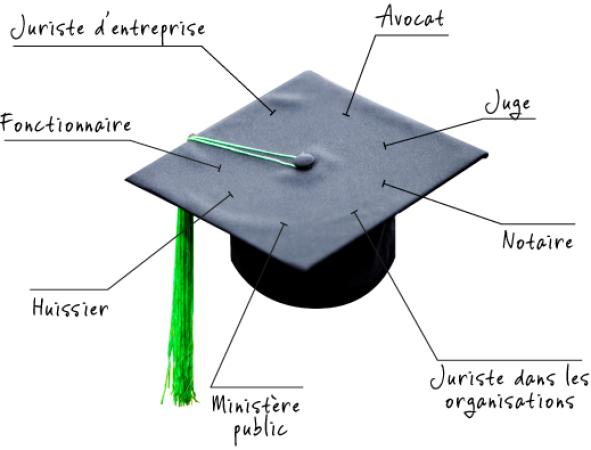
Legal professions
A constantly changing profession
Legal professions are evolving. It's no longer just a matter of intervening in litigation to defend a party or settle a dispute. Lawyers are also the advisors who prevent conflict by scrutinizing the applicable legislation or finalizing a contractual approach. Increasingly, they are called upon to intervene in non-judicial dispute resolution procedures, such as mediation.
Another notable development is internationalization. More and more cases have a foreign element, or are subject to supranational law such as European Union law. Finally, the development of information technologies is changing the day-to-day work of lawyers, while opening up new fields of specialization within the law.
The omnipresence of law in social and economic life explains the diversity of career opportunities open to legal professionals.
The professions of the lawyer
Lawyers are versatile professionals. The functions described here represent the core of the legal profession, but the list of outlets is far from exhaustive.
The judiciary
Magistrates are appointed for life by the King. There are two categories among them, the public prosecutor and the judges.
The Public Prosecutor's Office
Public prosecutors (known as "auditeurs" in first-degree labor courts) and their substitutes, grouped together in the Public Prosecutor's Office (also known as "the standing magistracy" or "the public prosecutor's office"), are in charge of public order. These magistrates prosecute offenders, coordinate police investigations, summon defendants to court and ensure that sentences are carried out. They intervene in economic and financial matters, environmental issues, computer crime, youth protection, social legislation offences... and of course in common law cases (traffic, vice, theft, assault...).
The public prosecutor may also be called upon to advise the court on the appropriate resolution of the dispute, in family matters, labor or social security law or in certain commercial cases.
Judges
Judges (also known as the "magistrature assise" or "the bench") are responsible for adjudicating disputes between individuals (in civil or social law matters) and judging those prosecuted for offenses (in criminal matters). Judges are appointed to various courts and tribunals, including justices of the peace, police courts, courts of first instance, labor courts, commercial courts, courts of appeal, labor courts and the Court of Cassation. Increasingly, judges are also playing a conciliatory role. Outside their hearings, judges study their cases, carry out the appropriate research and draft their judgments. Most judges are specialized. For example, police court judges mainly settle disputes relating to traffic offences and compensation for the consequences of road accidents; labor courts have jurisdiction over disputes between employers and workers, or in matters of safety and social welfare; justices of the peace hear rental disputes, relations between neighbors, and the protection of the mentally ill, among other matters; the family court has jurisdiction to settle family disputes and ensure the protection of children.
To become a magistrate, the main routes are, on the one hand, the competitive examination for admission to the judicial internship (followed by a 24-month internship) for those presenting at least two years' experience in a legal profession, and on the other hand the professional aptitude examination (allowing immediate appointment) for those demonstrating at least five years' experience in a legal profession to become a member of the public prosecutor's office and at least ten years to become a judge.
Notaries
The mission of notaries is to avoid conflicts between people wishing to reach agreements in the fields of real estate (purchase/sale of property, loans...), family (marriage contracts, gifts, inheritance...) and business (incorporation of companies, mergers...). They listen, advise and give opinions. They draw up authentic deeds that record agreements in writing, in a form that is legally unassailable. To embark on a career as a notary, you need, among other things, to pass a master's degree specializing in notarial practice and complete a three-year internship with an appointed notary.
Lawyers
Lawyers are self-employed individuals charged with advising clients facing legal problems in their private or professional lives, in strict compliance with legislation and ethical rules. Lawyers can assist their clients from the conception and launch of a project (drafting opinions and contracts) through to the various stages of dispute resolution (negotiation, mediation, legal proceedings). Their tasks are varied: researching legislation, case law and doctrine, drafting numerous written documents (letters, conclusions), organizing conciliation meetings, taking part in expert appraisals, pleadings... The lawyer's profession sometimes presents faces that are less familiar to the general public. For example, it is often lawyers who act as bankruptcy trustees, liquidators of a vacant estate, debt mediators, or administrators of the assets of vulnerable persons...
Lawyers newly admitted to the Bar must complete a three-year internship with an experienced lawyer before they can join the roll of the Ordre and practice the profession on their own. Many lawyers, however, choose to create or join associations, which in particular enables them to offer more specialized and diversified services.
Bailiffs
Bailiffs are public officers who intervene at various stages of legal proceedings. They communicate procedural documents to litigants (summonses, judgments, etc.). They are also responsible for enforcing court decisions, possibly through seizure. They draw up statements of facts (adultery, certain products on offer, unauthorized use of a brand name on a website, etc.). Their image is unfairly negative. In reality, they can play a conciliatory role, guaranteeing equal treatment for those subject to the law, while respecting everyone's rights. Law graduates can become bailiffs after two years' training and passing a competitive examination. After five years, they can then apply for a
vacant position as a "titular" bailiff.
Lawyers in public and private organizations
Company lawyers
Companies in general (industry, banking, insurance, telecommunications...) employ many lawyers in their various departments (human resources management, litigation, regulations...). Only members of the Institut des juristes d'entreprise can hold the corresponding title. These specialists are consulted on a daily basis by their employers on all legal issues (commercial, tax, environmental, social, etc.). For example, they advise on drafting and negotiating contracts. They also intervene in the event of litigation, although they do not represent the company in court, as they are not lawyers. Finally, they guarantee the legality of the various decision-making procedures within the company (they prepare boards of directors, for example).
Officials
In public services at federal, regional, community, provincial or municipal level (federal public services - SPF, CPAS, ONEM, Forem...), lawyers prepare opinions for managers on matters specific to their administration, focusing on the legal aspects. They play an active role in the preparation of legislative and regulatory texts.
Lawyers in organizations
Depending on their specialties, lawyers are also invaluable advisors in the non-commercial world and in associations (mutual societies, trade unions, consumer associations...), as well as in international organizations (European Commission, UN, International Court of Justice...).
The police
Frequent outlets for lawyers include the police, both in operational (investigations) and administrative settings.
Research and teaching
Some law graduates pursue a research activity in Belgium or abroad. Universities and public funds (e.g. FNRS) finance the completion of a doctorate (usually four years). Alongside other forms of fundamental legal research, "applied" research is generally based on partnerships with companies or public institutions that wish to develop new products or services and have questions about the legal framework. For example, what legal constraints need to be taken into account when setting up an internet sales service, what rules apply to the use of artificial intelligence by the judicial system?
Finally, some lawyers teach in high schools, in higher education or in the world of continuing education.
Les métiers des juristes
Legal professions
A constantly changing profession
Legal professions are evolving. It's no longer just a matter of intervening in litigation to defend a party or settle a dispute. Lawyers are also the advisors who prevent conflict by scrutinizing the applicable legislation or finalizing a contractual approach. Increasingly, they are called upon to intervene in non-judicial dispute resolution procedures, such as mediation.
Another notable development is internationalization. More and more cases have a foreign element, or are subject to supranational law such as European Union law. Finally, the development of information technologies is changing the day-to-day work of lawyers, while opening up new fields of specialization within the law.
The omnipresence of law in social and economic life explains the diversity of career opportunities open to legal professionals.
The professions of the lawyer
Lawyers are versatile professionals. The functions described here represent the core of the legal profession, but the list of outlets is far from exhaustive.
The judiciary
Magistrates are appointed for life by the King. There are two categories among them, the public prosecutor and the judges.
The Public Prosecutor's Office
Public prosecutors (known as "auditeurs" in first-degree labor courts) and their substitutes, grouped together in the Public Prosecutor's Office (also known as "the standing magistracy" or "the public prosecutor's office"), are in charge of public order. These magistrates prosecute offenders, coordinate police investigations, summon defendants to court and ensure that sentences are carried out. They intervene in economic and financial matters, environmental issues, computer crime, youth protection, social legislation offences... and of course in common law cases (traffic, vice, theft, assault...).
The public prosecutor may also be called upon to advise the court on the appropriate resolution of the dispute, in family matters, labor or social security law or in certain commercial cases.
Judges
Judges (also known as the "magistrature assise" or "the bench") are responsible for adjudicating disputes between individuals (in civil or social law matters) and judging those prosecuted for offenses (in criminal matters). Judges are appointed to various courts and tribunals, including justices of the peace, police courts, courts of first instance, labor courts, commercial courts, courts of appeal, labor courts and the Court of Cassation. Increasingly, judges are also playing a conciliatory role. Outside their hearings, judges study their cases, carry out the appropriate research and draft their judgments. Most judges are specialized. For example, police court judges mainly settle disputes relating to traffic offences and compensation for the consequences of road accidents; labor courts have jurisdiction over disputes between employers and workers, or in matters of safety and social welfare; justices of the peace hear rental disputes, relations between neighbors, and the protection of the mentally ill, among other matters; the family court has jurisdiction to settle family disputes and ensure the protection of children.
To become a magistrate, the main routes are, on the one hand, the competitive examination for admission to the judicial internship (followed by a 24-month internship) for those presenting at least two years' experience in a legal profession, and on the other hand the professional aptitude examination (allowing immediate appointment) for those demonstrating at least five years' experience in a legal profession to become a member of the public prosecutor's office and at least ten years to become a judge.
Notaries
The mission of notaries is to avoid conflicts between people wishing to reach agreements in the fields of real estate (purchase/sale of property, loans...), family (marriage contracts, gifts, inheritance...) and business (incorporation of companies, mergers...). They listen, advise and give opinions. They draw up authentic deeds that record agreements in writing, in a form that is legally unassailable. To embark on a career as a notary, you need, among other things, to pass a master's degree specializing in notarial practice and complete a three-year internship with an appointed notary.
Lawyers
Lawyers are self-employed individuals charged with advising clients facing legal problems in their private or professional lives, in strict compliance with legislation and ethical rules. Lawyers can assist their clients from the conception and launch of a project (drafting opinions and contracts) through to the various stages of dispute resolution (negotiation, mediation, legal proceedings). Their tasks are varied: researching legislation, case law and doctrine, drafting numerous written documents (letters, conclusions), organizing conciliation meetings, taking part in expert appraisals, pleadings... The lawyer's profession sometimes presents faces that are less familiar to the general public. For example, it is often lawyers who act as bankruptcy trustees, liquidators of a vacant estate, debt mediators, or administrators of the assets of vulnerable persons...
Lawyers newly admitted to the Bar must complete a three-year internship with an experienced lawyer before they can join the roll of the Ordre and practice the profession on their own. Many lawyers, however, choose to create or join associations, which in particular enables them to offer more specialized and diversified services.
Bailiffs
Bailiffs are public officers who intervene at various stages of legal proceedings. They communicate procedural documents to litigants (summonses, judgments, etc.). They are also responsible for enforcing court decisions, possibly through seizure. They draw up statements of facts (adultery, certain products on offer, unauthorized use of a brand name on a website, etc.). Their image is unfairly negative. In reality, they can play a conciliatory role, guaranteeing equal treatment for those subject to the law, while respecting everyone's rights. Law graduates can become bailiffs after two years' training and passing a competitive examination. After five years, they can then apply for a
vacant position as a "titular" bailiff.
Lawyers in public and private organizations
Company lawyers
Companies in general (industry, banking, insurance, telecommunications...) employ many lawyers in their various departments (human resources management, litigation, regulations...). Only members of the Institut des juristes d'entreprise can hold the corresponding title. These specialists are consulted on a daily basis by their employers on all legal issues (commercial, tax, environmental, social, etc.). For example, they advise on drafting and negotiating contracts. They also intervene in the event of litigation, although they do not represent the company in court, as they are not lawyers. Finally, they guarantee the legality of the various decision-making procedures within the company (they prepare boards of directors, for example).
Officials
In public services at federal, regional, community, provincial or municipal level (federal public services - SPF, CPAS, ONEM, Forem...), lawyers prepare opinions for managers on matters specific to their administration, focusing on the legal aspects. They play an active role in the preparation of legislative and regulatory texts.
Lawyers in organizations
Depending on their specialties, lawyers are also invaluable advisors in the non-commercial world and in associations (mutual societies, trade unions, consumer associations...), as well as in international organizations (European Commission, UN, International Court of Justice...).
The police
Frequent outlets for lawyers include the police, both in operational (investigations) and administrative settings.
Research and teaching
Some law graduates pursue a research activity in Belgium or abroad. Universities and public funds (e.g. FNRS) finance the completion of a doctorate (usually four years). Alongside other forms of fundamental legal research, "applied" research is generally based on partnerships with companies or public institutions that wish to develop new products or services and have questions about the legal framework. For example, what legal constraints need to be taken into account when setting up an internet sales service, what rules apply to the use of artificial intelligence by the judicial system?
Finally, some lawyers teach in high schools, in higher education or in the world of continuing education.
Les métiers des juristes
Legal professions
A constantly changing profession
Legal professions are evolving. It's no longer just a matter of intervening in litigation to defend a party or settle a dispute. Lawyers are also the advisors who prevent conflict by scrutinizing the applicable legislation or finalizing a contractual approach. Increasingly, they are called upon to intervene in non-judicial dispute resolution procedures, such as mediation.
Another notable development is internationalization. More and more cases have a foreign element, or are subject to supranational law such as European Union law. Finally, the development of information technologies is changing the day-to-day work of lawyers, while opening up new fields of specialization within the law.
The omnipresence of law in social and economic life explains the diversity of career opportunities open to legal professionals.
The professions of the lawyer
Lawyers are versatile professionals. The functions described here represent the core of the legal profession, but the list of outlets is far from exhaustive.
The judiciary
Magistrates are appointed for life by the King. There are two categories among them, the public prosecutor and the judges.
The Public Prosecutor's Office
Public prosecutors (known as "auditeurs" in first-degree labor courts) and their substitutes, grouped together in the Public Prosecutor's Office (also known as "the standing magistracy" or "the public prosecutor's office"), are in charge of public order. These magistrates prosecute offenders, coordinate police investigations, summon defendants to court and ensure that sentences are carried out. They intervene in economic and financial matters, environmental issues, computer crime, youth protection, social legislation offences... and of course in common law cases (traffic, vice, theft, assault...).
The public prosecutor may also be called upon to advise the court on the appropriate resolution of the dispute, in family matters, labor or social security law or in certain commercial cases.
Judges
Judges (also known as the "magistrature assise" or "the bench") are responsible for adjudicating disputes between individuals (in civil or social law matters) and judging those prosecuted for offenses (in criminal matters). Judges are appointed to various courts and tribunals, including justices of the peace, police courts, courts of first instance, labor courts, commercial courts, courts of appeal, labor courts and the Court of Cassation. Increasingly, judges are also playing a conciliatory role. Outside their hearings, judges study their cases, carry out the appropriate research and draft their judgments. Most judges are specialized. For example, police court judges mainly settle disputes relating to traffic offences and compensation for the consequences of road accidents; labor courts have jurisdiction over disputes between employers and workers, or in matters of safety and social welfare; justices of the peace hear rental disputes, relations between neighbors, and the protection of the mentally ill, among other matters; the family court has jurisdiction to settle family disputes and ensure the protection of children.
To become a magistrate, the main routes are, on the one hand, the competitive examination for admission to the judicial internship (followed by a 24-month internship) for those presenting at least two years' experience in a legal profession, and on the other hand the professional aptitude examination (allowing immediate appointment) for those demonstrating at least five years' experience in a legal profession to become a member of the public prosecutor's office and at least ten years to become a judge.
Notaries
The mission of notaries is to avoid conflicts between people wishing to reach agreements in the fields of real estate (purchase/sale of property, loans...), family (marriage contracts, gifts, inheritance...) and business (incorporation of companies, mergers...). They listen, advise and give opinions. They draw up authentic deeds that record agreements in writing, in a form that is legally unassailable. To embark on a career as a notary, you need, among other things, to pass a master's degree specializing in notarial practice and complete a three-year internship with an appointed notary.
Lawyers
Lawyers are self-employed individuals charged with advising clients facing legal problems in their private or professional lives, in strict compliance with legislation and ethical rules. Lawyers can assist their clients from the conception and launch of a project (drafting opinions and contracts) through to the various stages of dispute resolution (negotiation, mediation, legal proceedings). Their tasks are varied: researching legislation, case law and doctrine, drafting numerous written documents (letters, conclusions), organizing conciliation meetings, taking part in expert appraisals, pleadings... The lawyer's profession sometimes presents faces that are less familiar to the general public. For example, it is often lawyers who act as bankruptcy trustees, liquidators of a vacant estate, debt mediators, or administrators of the assets of vulnerable persons...
Lawyers newly admitted to the Bar must complete a three-year internship with an experienced lawyer before they can join the roll of the Ordre and practice the profession on their own. Many lawyers, however, choose to create or join associations, which in particular enables them to offer more specialized and diversified services.
Bailiffs
Bailiffs are public officers who intervene at various stages of legal proceedings. They communicate procedural documents to litigants (summonses, judgments, etc.). They are also responsible for enforcing court decisions, possibly through seizure. They draw up statements of facts (adultery, certain products on offer, unauthorized use of a brand name on a website, etc.). Their image is unfairly negative. In reality, they can play a conciliatory role, guaranteeing equal treatment for those subject to the law, while respecting everyone's rights. Law graduates can become bailiffs after two years' training and passing a competitive examination. After five years, they can then apply for a
vacant position as a "titular" bailiff.
Lawyers in public and private organizations
Company lawyers
Companies in general (industry, banking, insurance, telecommunications...) employ many lawyers in their various departments (human resources management, litigation, regulations...). Only members of the Institut des juristes d'entreprise can hold the corresponding title. These specialists are consulted on a daily basis by their employers on all legal issues (commercial, tax, environmental, social, etc.). For example, they advise on drafting and negotiating contracts. They also intervene in the event of litigation, although they do not represent the company in court, as they are not lawyers. Finally, they guarantee the legality of the various decision-making procedures within the company (they prepare boards of directors, for example).
Officials
In public services at federal, regional, community, provincial or municipal level (federal public services - SPF, CPAS, ONEM, Forem...), lawyers prepare opinions for managers on matters specific to their administration, focusing on the legal aspects. They play an active role in the preparation of legislative and regulatory texts.
Lawyers in organizations
Depending on their specialties, lawyers are also invaluable advisors in the non-commercial world and in associations (mutual societies, trade unions, consumer associations...), as well as in international organizations (European Commission, UN, International Court of Justice...).
The police
Frequent outlets for lawyers include the police, both in operational (investigations) and administrative settings.
Research and teaching
Some law graduates pursue a research activity in Belgium or abroad. Universities and public funds (e.g. FNRS) finance the completion of a doctorate (usually four years). Alongside other forms of fundamental legal research, "applied" research is generally based on partnerships with companies or public institutions that wish to develop new products or services and have questions about the legal framework. For example, what legal constraints need to be taken into account when setting up an internet sales service, what rules apply to the use of artificial intelligence by the judicial system?
Finally, some lawyers teach in high schools, in higher education or in the world of continuing education.
Les métiers des juristes
Legal professions
A constantly changing profession
Legal professions are evolving. It's no longer just a matter of intervening in litigation to defend a party or settle a dispute. Lawyers are also the advisors who prevent conflict by scrutinizing the applicable legislation or finalizing a contractual approach. Increasingly, they are called upon to intervene in non-judicial dispute resolution procedures, such as mediation.
Another notable development is internationalization. More and more cases have a foreign element, or are subject to supranational law such as European Union law. Finally, the development of information technologies is changing the day-to-day work of lawyers, while opening up new fields of specialization within the law.
The omnipresence of law in social and economic life explains the diversity of career opportunities open to legal professionals.
The professions of the lawyer
Lawyers are versatile professionals. The functions described here represent the core of the legal profession, but the list of outlets is far from exhaustive.
The judiciary
Magistrates are appointed for life by the King. There are two categories among them, the public prosecutor and the judges.
The Public Prosecutor's Office
Public prosecutors (known as "auditeurs" in first-degree labor courts) and their substitutes, grouped together in the Public Prosecutor's Office (also known as "the standing magistracy" or "the public prosecutor's office"), are in charge of public order. These magistrates prosecute offenders, coordinate police investigations, summon defendants to court and ensure that sentences are carried out. They intervene in economic and financial matters, environmental issues, computer crime, youth protection, social legislation offences... and of course in common law cases (traffic, vice, theft, assault...).
The public prosecutor may also be called upon to advise the court on the appropriate resolution of the dispute, in family matters, labor or social security law or in certain commercial cases.
Judges
Judges (also known as the "magistrature assise" or "the bench") are responsible for adjudicating disputes between individuals (in civil or social law matters) and judging those prosecuted for offenses (in criminal matters). Judges are appointed to various courts and tribunals, including justices of the peace, police courts, courts of first instance, labor courts, commercial courts, courts of appeal, labor courts and the Court of Cassation. Increasingly, judges are also playing a conciliatory role. Outside their hearings, judges study their cases, carry out the appropriate research and draft their judgments. Most judges are specialized. For example, police court judges mainly settle disputes relating to traffic offences and compensation for the consequences of road accidents; labor courts have jurisdiction over disputes between employers and workers, or in matters of safety and social welfare; justices of the peace hear rental disputes, relations between neighbors, and the protection of the mentally ill, among other matters; the family court has jurisdiction to settle family disputes and ensure the protection of children.
To become a magistrate, the main routes are, on the one hand, the competitive examination for admission to the judicial internship (followed by a 24-month internship) for those presenting at least two years' experience in a legal profession, and on the other hand the professional aptitude examination (allowing immediate appointment) for those demonstrating at least five years' experience in a legal profession to become a member of the public prosecutor's office and at least ten years to become a judge.
Notaries
The mission of notaries is to avoid conflicts between people wishing to reach agreements in the fields of real estate (purchase/sale of property, loans...), family (marriage contracts, gifts, inheritance...) and business (incorporation of companies, mergers...). They listen, advise and give opinions. They draw up authentic deeds that record agreements in writing, in a form that is legally unassailable. To embark on a career as a notary, you need, among other things, to pass a master's degree specializing in notarial practice and complete a three-year internship with an appointed notary.
Lawyers
Lawyers are self-employed individuals charged with advising clients facing legal problems in their private or professional lives, in strict compliance with legislation and ethical rules. Lawyers can assist their clients from the conception and launch of a project (drafting opinions and contracts) through to the various stages of dispute resolution (negotiation, mediation, legal proceedings). Their tasks are varied: researching legislation, case law and doctrine, drafting numerous written documents (letters, conclusions), organizing conciliation meetings, taking part in expert appraisals, pleadings... The lawyer's profession sometimes presents faces that are less familiar to the general public. For example, it is often lawyers who act as bankruptcy trustees, liquidators of a vacant estate, debt mediators, or administrators of the assets of vulnerable persons...
Lawyers newly admitted to the Bar must complete a three-year internship with an experienced lawyer before they can join the roll of the Ordre and practice the profession on their own. Many lawyers, however, choose to create or join associations, which in particular enables them to offer more specialized and diversified services.
Bailiffs
Bailiffs are public officers who intervene at various stages of legal proceedings. They communicate procedural documents to litigants (summonses, judgments, etc.). They are also responsible for enforcing court decisions, possibly through seizure. They draw up statements of facts (adultery, certain products on offer, unauthorized use of a brand name on a website, etc.). Their image is unfairly negative. In reality, they can play a conciliatory role, guaranteeing equal treatment for those subject to the law, while respecting everyone's rights. Law graduates can become bailiffs after two years' training and passing a competitive examination. After five years, they can then apply for a
vacant position as a "titular" bailiff.
Lawyers in public and private organizations
Company lawyers
Companies in general (industry, banking, insurance, telecommunications...) employ many lawyers in their various departments (human resources management, litigation, regulations...). Only members of the Institut des juristes d'entreprise can hold the corresponding title. These specialists are consulted on a daily basis by their employers on all legal issues (commercial, tax, environmental, social, etc.). For example, they advise on drafting and negotiating contracts. They also intervene in the event of litigation, although they do not represent the company in court, as they are not lawyers. Finally, they guarantee the legality of the various decision-making procedures within the company (they prepare boards of directors, for example).
Officials
In public services at federal, regional, community, provincial or municipal level (federal public services - SPF, CPAS, ONEM, Forem...), lawyers prepare opinions for managers on matters specific to their administration, focusing on the legal aspects. They play an active role in the preparation of legislative and regulatory texts.
Lawyers in organizations
Depending on their specialties, lawyers are also invaluable advisors in the non-commercial world and in associations (mutual societies, trade unions, consumer associations...), as well as in international organizations (European Commission, UN, International Court of Justice...).
The police
Frequent outlets for lawyers include the police, both in operational (investigations) and administrative settings.
Research and teaching
Some law graduates pursue a research activity in Belgium or abroad. Universities and public funds (e.g. FNRS) finance the completion of a doctorate (usually four years). Alongside other forms of fundamental legal research, "applied" research is generally based on partnerships with companies or public institutions that wish to develop new products or services and have questions about the legal framework. For example, what legal constraints need to be taken into account when setting up an internet sales service, what rules apply to the use of artificial intelligence by the judicial system?
Finally, some lawyers teach in high schools, in higher education or in the world of continuing education.